A face for each part of the day
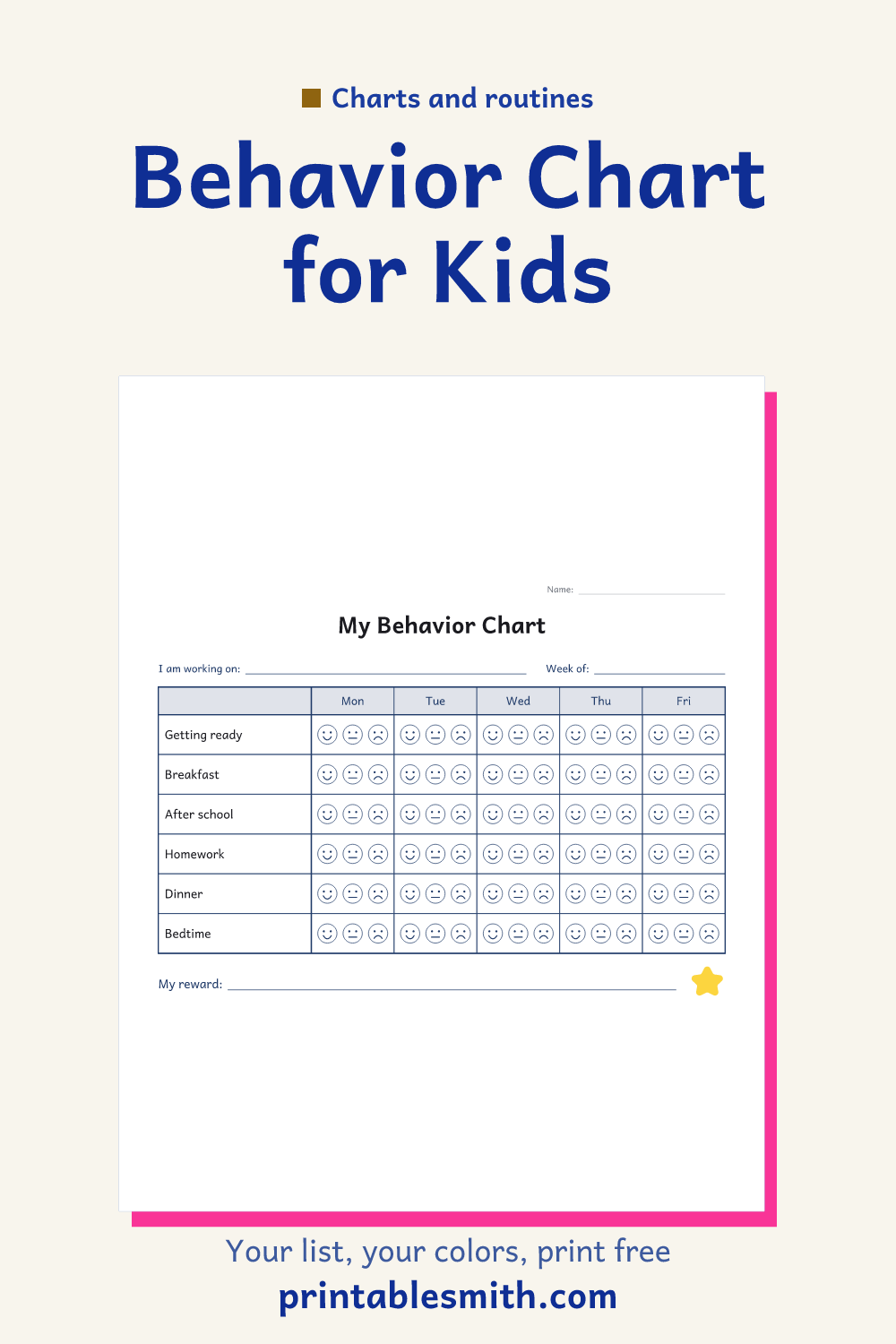
A behavior chart breaks the day into parts, such as getting ready, school, homework and bedtime, and gives each one a place to mark how it went. At the end of each part, the child circles a face (a smile, a straight face or a frown) or colors a star. Over the week, both of you can see which times go well and which need help.
Parents use behavior charts at home, often beside a reward chart. Teachers use them by subject for one child or for each child in a class, and some send them home each day so families can follow along.
How to make a behavior chart
- Pick a ready-made set (at home, at school or for little ones), or type the parts of the day or subjects, one per line.
- Write the goal you are working on, such as “I use kind words”, or leave the line to fill in together.
- Choose faces to circle or a star to color, and Monday to Friday or the whole week.
- To make a chart for each child, type every name on its own line under “For a class”: each gets a page with the name filled in.
- Pick a color, or Black to save ink. The chart prints on a page on its side, so the faces are big enough to circle.
Save it for later
Pin this sheet to find it again next time, or to share it with another teacher or parent. The link brings them straight to this page, ready to print.
Save to PinterestTips for a behavior chart that helps
- Work on one goal at a time, written the way your child would say it: “I keep my hands to myself”.
- Talk about the chart together at the end of each part of the day, and start with what went well.
- Count the smiles or stars, not the frowns. A good day is one with more smiles than yesterday.
- Agree on a small reward for a good week before it starts.
- In a classroom, keep each child’s chart private, between the child, the teacher and the family.
- Start each week with a fresh chart, and change the rows when the routine changes.
Common questions
Is the behavior chart maker free?
Yes. Every chart is free to download and print, with no account, no email and no watermark.
What age is a behavior chart for?
Faces work well from around age three, when a child can tell a smile from a frown. Stars and longer lists of subjects suit school-age children.
Faces or stars?
Faces let a child say how a part of the day went, good, so-so or hard. Stars mark only the good parts, which some children find more hopeful. Choose under Each day.
Can I make a behavior chart for my classroom?
Yes. Choose the At school set, change the subjects to your class schedule, and type each student’s name on its own line under “For a class” to print a chart for each.
Can I print a chart for the whole week?
Yes. Choose Whole week under Days, and the day your week starts under More.
Can I print it in black and white?
Yes. Choose Black under Look: the chart prints in black lines and words, with black faces or stars.
Can I save my chart?
Use “Copy link to this chart”. The link rebuilds the same rows, goal and settings, but never the children’s names, which stay on this device.