What a heart word sheet does
A heart word is a common word with a part that does not follow the spelling patterns a child has learned yet. In "said", the s and the d sound the way they look; only the "ai", which says the short e of "bed", has to be learned by heart. So the child sounds out what they can and remembers one small part, instead of memorizing the whole word as a shape.
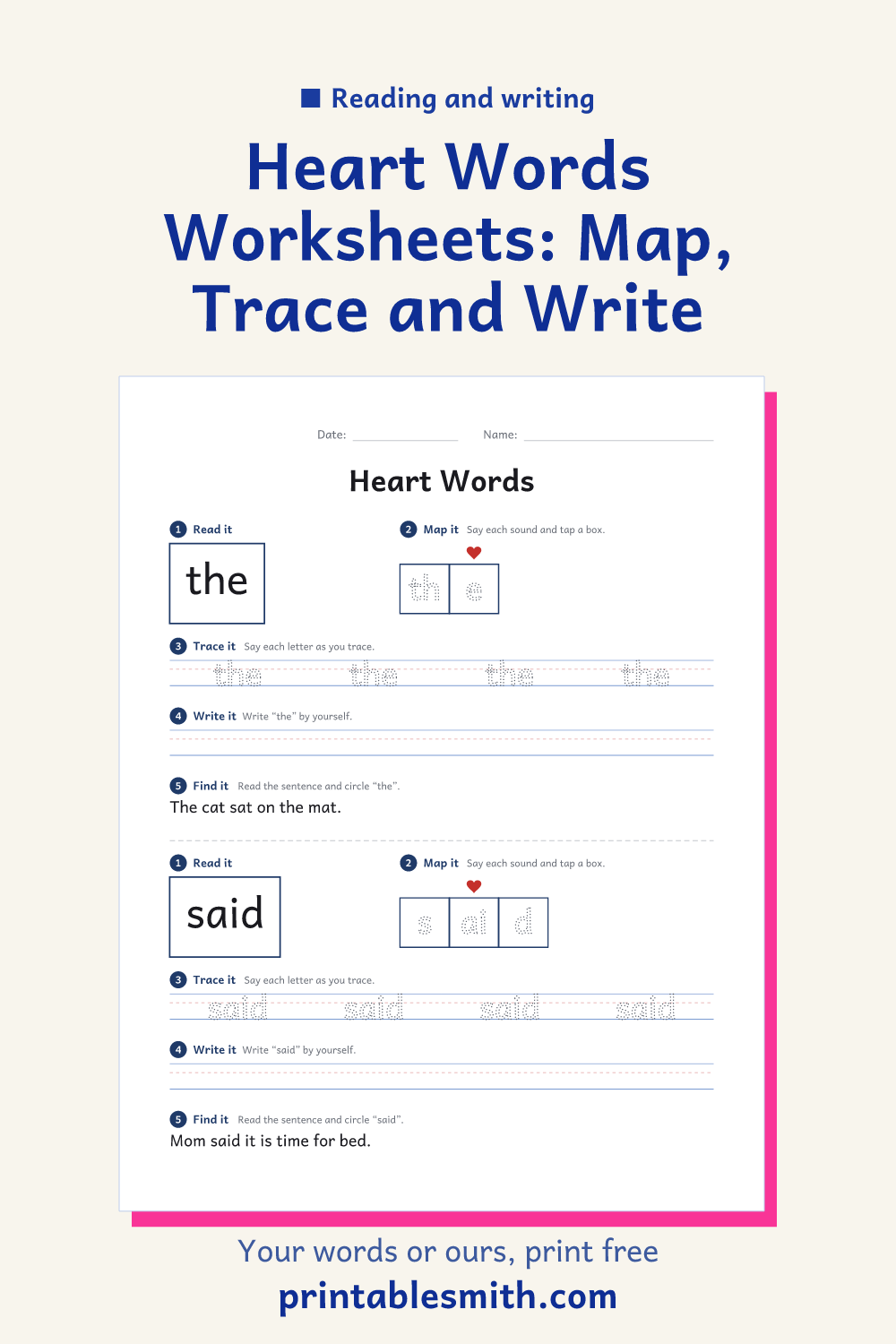
Each word on this sheet goes through five steps. Read it: the word large in a box. Map it: one box for each sound, so "the" has two boxes (th, e) and "said" has three (s, ai, d), with a heart drawn over the part to learn by heart. Then trace it on handwriting lines, write it alone, and find it in a short sentence (a word of your own, not on the lists, gets lines to write a sentence instead). Two words fit on a page, one prints larger, and the mapping chart puts eight words on a page for review.
A kindergarten teacher with a small group at the kidney table hands out the "said" page, and the children tap three boxes as they say s, then e, then d. They color the heart red, trace "said" three times and circle it in "Mom said it is time for bed." Five minutes, and the tricky part has a name.
How to make heart word worksheets
- Type your words, one a line, or choose a grade list and press Fill in. Every Dolch word from pre-primer to second grade is already mapped.
- Choose two words a page, one word a page, or the mapping chart of eight.
- Choose what the sound boxes show: the letters, letters to trace, or empty boxes for the child to fill. The hearts stay over their boxes either way.
- For a word that is not on the lists, write its map after an equals sign: split the sounds with dashes and mark the heart part with a star, as in said = s-ai*-d.
- Download the PDF or print. Copy link keeps your list, so next week’s words are one edit away.
Save it for later
Pin this sheet to find it again next time, or to share it with another teacher or parent. The link brings them straight to this page, ready to print.
Save to PinterestMore sheets from this maker to pin:


Tips for teaching heart words
- Say the word, then tap a box for each sound before anyone writes. Children who skip the tapping tend to copy letters without hearing the sounds.
- Ask which part does not sound the way it looks, and only then point to the heart. Children remember a heart they found themselves.
- Teach two or three new heart words a week and review the old ones on the mapping chart every Friday.
- Some hearts come off once a pattern is taught. In "make", the a and silent e are regular once a child knows silent e, so this list leaves it without a heart. Words such as "of" and "one" keep theirs for good.
- Read the sentence aloud before the child looks for the word, so the step is about finding it, not decoding the rest.
Heart words questions
What are heart words?
Heart words are high-frequency words with one or more parts that do not follow the spelling patterns a child knows. The regular parts are sounded out, and only the irregular part is learned by heart, which is why it gets a heart over it.
Are heart words the same as sight words?
No. Sight words are any words a child reads at once, without sounding them out. Heart words are a way of teaching some of them: map the sounds, then learn only the part that breaks the pattern. Many sight words, such as "can" and "big", have no heart part at all.
Why are they called heart words?
Because the tricky part is learned "by heart". Teachers draw a heart over that part so the child knows which letters to remember and which to sound out.
What is heart word mapping?
It is matching each sound in a word to the letters that spell it. The child says the word, taps a box for each sound, writes the letters for each sound in its box and draws a heart over any box whose letters do not spell the sound the usual way.
Which part of a word gets the heart?
The letters that do not spell their sound the usual way. In "said" it is "ai", in "was" both the a and the s (which says z), in "of" both letters, since o says the u in "up" and f says v.
Can I use my school’s list?
Yes. Paste any words, one a line. Words from the Dolch lists print with their maps and sentences; for any other word, add a map after an equals sign, such as friend = f-r-ie*-n-d, or leave it and the boxes print empty for you to mark.
How many heart words should a child learn a week?
Two to four new words is common in kindergarten and first grade, with the earlier ones reviewed every day. Fewer words, mapped and used in sentences, last longer than a long list read once.