Every division fact from 1 to 12
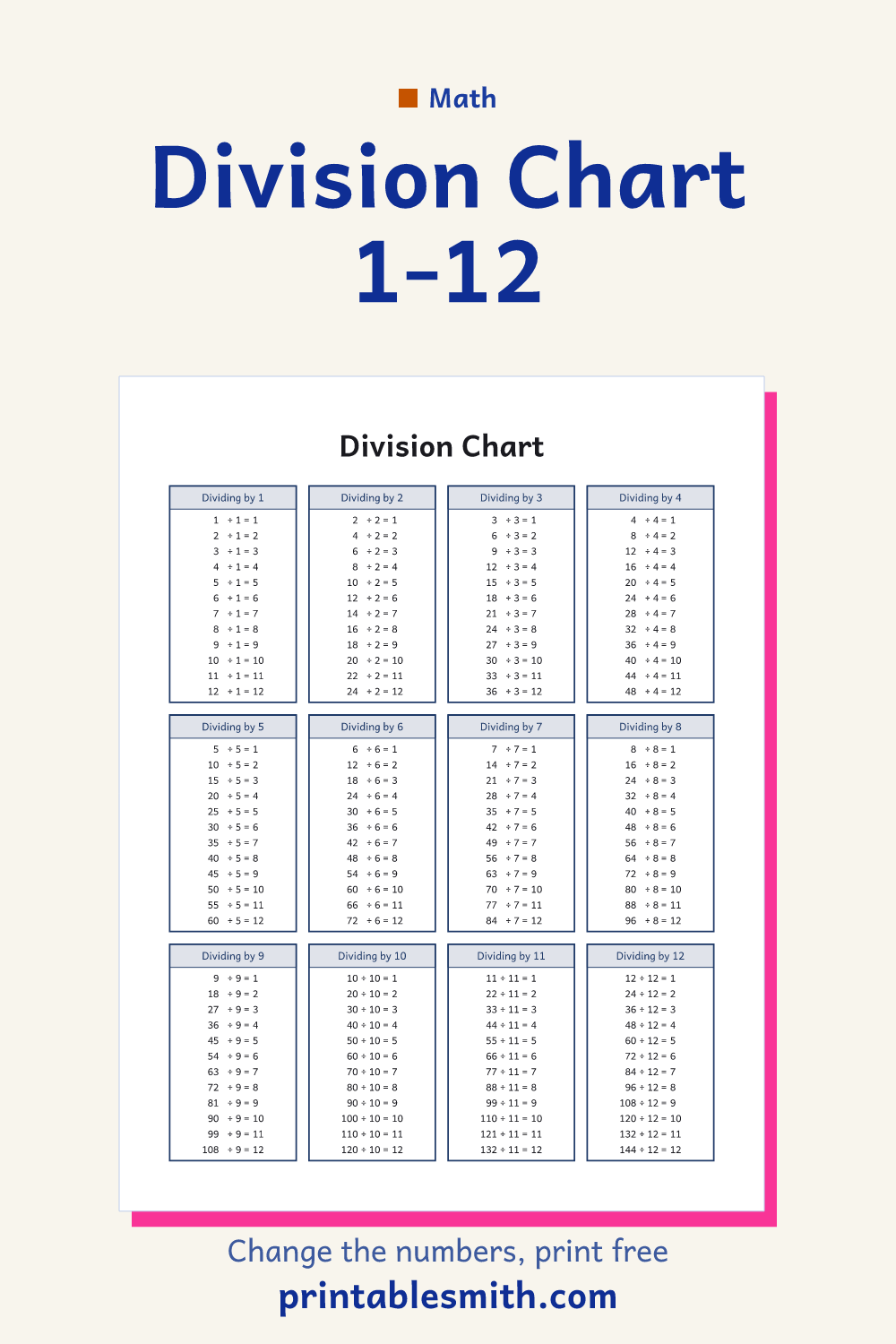
A division chart lists the division facts children learn in third and fourth grade. In the facts list each number from 1 to 12 has its own box, from 1 ÷ 1 = 1 down to 144 ÷ 12 = 12. The grid holds the same facts as a table: the numbers you divide by run down the side, the answers along the top, and the numbers being divided fill the squares.
A third grader stuck on 56 ÷ 8 at the kitchen table can find the box for 8, run down to 56 and read the 7. Teachers tape a filled-in list inside the homework folder, then hand out the same list with the answers blank as the Friday check.
How to print a division chart
- Choose Facts list or Grid. The facts list is a box for each number you divide by; the grid is a square table.
- Choose the size: 1 to 10, 1 to 12, 1 to 15 or 1 to 20.
- Choose Filled in, Blank or Fill in some. On a facts list, choose under Leave out whether the answers, the numbers divided or a mix of the two are lines to write on.
- For Fill in some, choose a quarter, half or three quarters. Under For a class, print up to 30 different sheets, each with its own answer key.
- Pick a color under Look, or black to save ink, then download or print the PDF. Answer keys follow the sheets, with the missing numbers in red.
Save it for later
Pin this sheet to find it again next time, or to share it with another teacher or parent. The link brings them straight to this page, ready to print.
Save to PinterestTips for learning division facts
- To read the grid for 63 ÷ 9, find 9 down the side, move along its row to 63, then look up to the top of that column. It says 7, so 63 ÷ 9 = 7.
- Keep the multiplication chart beside it. Every division fact is a multiplication fact run backward: 8 × 7 = 56 means 56 ÷ 8 = 7 and 56 ÷ 7 = 8.
- Start with dividing by 2, 5 and 10, which follow the skip-counting patterns children already know, and leave 7 and 8 for last.
- Once the answers come quickly, leave out the numbers divided instead. A line like __ ÷ 4 = 6 makes a child multiply to find the start.
- On the grid, highlight Square numbers. Facts like 49 ÷ 7 = 7 are often the first ones children remember, and the facts beside them follow.
- Cut a filled-in list into its twelve boxes, punch a hole in each and add one a week to a ring, so the facts already learned stay in reach.
Common questions
Is it free?
Yes, every chart and every answer key. No account, no email and no watermark.
How do you use a division chart?
Find the number you divide by, then find the number being divided in its box or row. The answer is beside it in the list, or at the top of its column in the grid: in the 9 row, 63 sits under the 7.
What is the difference between a division chart and a division table?
Usually none: both names cover the same facts. Here, Facts list prints a box for each number and Grid prints the square table, so you can print either one.
Is there a division chart 1-100?
Yes: choose 1 to 10. It holds the 100 facts from 1 ÷ 1 to 100 ÷ 10, the ones behind a 10 × 10 times table. Choose 1 to 12 for facts up to 144.
Can I use a multiplication chart for division?
Yes. Division undoes multiplication, so the multiplication chart holds every division fact. This chart prints them the way division is written, with the ÷ sign, which a child finds easier to read.
How many division facts are there to 12?
There are 144: twelve facts for each number from 1 to 12. Dividing by 1 to 10 gives 100.
Can I print it in black and white?
Yes. Choose Black under Look: the chart prints in lines and numbers only, with any highlight in light gray.
Can I print the same sheets again?
Use “Copy link to this chart”. The link rebuilds the same chart, with the same blanks to fill in. Charts you download or print on this device are also listed under “Your recent sheets”.