Sound boxes for hearing each sound
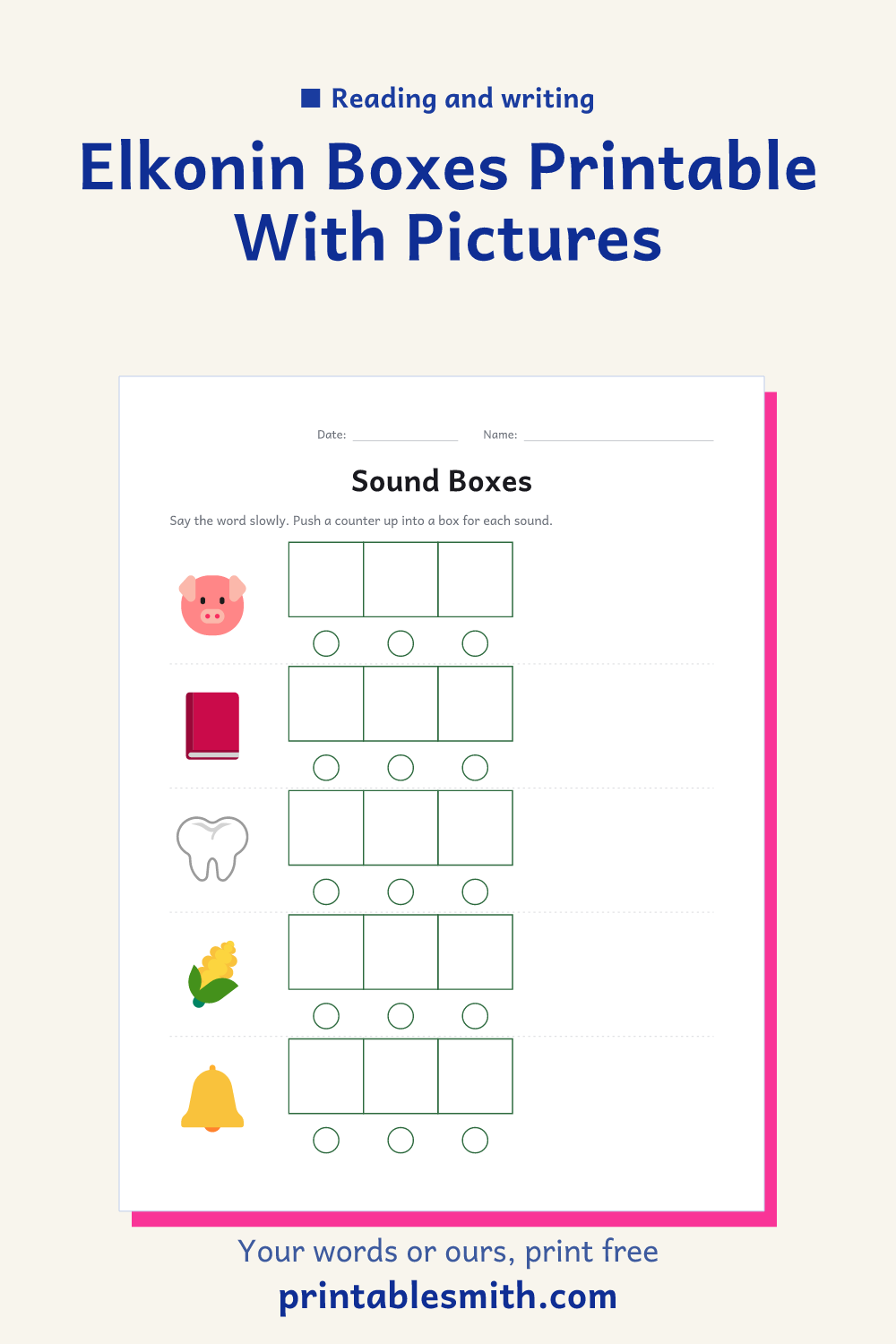
Elkonin boxes, also called sound boxes, help a child hear the separate sounds in a word. Each row shows a picture and a row of boxes, one for each sound: "cat" gets three, "ship" gets three too (sh, i, p), and "frog" gets four. The child says the word slowly and pushes a counter into a box for each sound, then, once they know letters, writes the letters that spell each sound.
The boxes are named after Daniil Elkonin, a Soviet psychologist who studied how children learn to read and used them in the 1960s. Speech therapists, reading specialists and kindergarten teachers still use them daily, because they turn a sound the child cannot see into a box they can touch.
This maker counts the boxes from each word’s sounds, never its letters: "duck" has four letters and three boxes, and "sheep" has five letters and three (sh, ee, p). Choose 2, 3, 4 or 5 sounds, or 3 to 5 mixed, and empty boxes, counters to push, lines to write the letters, or letters to trace. A reading tutor with a first grader who writes "fg" for "frog" starts on four-sound boxes with counters; after two sessions the child pushes four counters and writes all four letters.
How to make Elkonin boxes
- Choose how many sounds each word has: 2, 3, 4, 5 or 3 to 5 mixed.
- Choose the boxes: empty, counters to push, lines to write the letters, or letters to trace.
- Tick the word under each picture if a grown-up or older child will be reading along.
- Choose how many pages: five pictures a page with counters, six with the other boxes, never one twice on a page. New mix deals them again.
- Download the PDF or print. Use coins, beans or small blocks as counters.
Save it for later
Pin this sheet to find it again next time, or to share it with another teacher or parent. The link brings them straight to this page, ready to print.
Save to PinterestMore sheets from this maker to pin:


Tips for using sound boxes
- Model first: say the word slowly, stretching each sound, and push a counter as you say it.
- Start with two and three sounds, and words that begin with sounds you can hold, such as m, s and f.
- Once counters are easy, switch to lines to write the letters, so the child connects each sound to its spelling.
- For digraphs, point out that sh, ch and th are two letters in one box, because they make one sound.
- Slide a sheet into a clear plastic sleeve and use a dry-erase marker, so one page lasts a whole week.
Elkonin boxes questions
What are Elkonin boxes?
Elkonin boxes are a row of boxes, one for each sound in a word, often under a picture. A child says the word and moves a counter into a box for each sound they hear, which trains them to break words into sounds before reading and spelling them.
Who invented Elkonin boxes?
Daniil Elkonin, a Soviet psychologist, who described them in his work on how children learn to read in the 1960s. That is where the name comes from; they are also called sound boxes.
How do you use Elkonin boxes?
Say the picture’s word slowly. Push one counter into a box for each sound, left to right. Then say the word fast. Later, write the letters for each sound in its box.
How many boxes does "ship" have?
Three: sh, i and p. Boxes count sounds, not letters, so the two letters of sh share one box.
Do letters go in Elkonin boxes?
Not at first: the boxes start with counters, for hearing sounds alone. Once a child knows letter sounds, they write the letters that spell each sound in its box, which this maker prints as a line in each box.
How do Elkonin boxes work with silent e?
The silent e makes no sound, so it gets no box. In "cake" there are three boxes (c, a, k), and the e is written in the last box with the k, joined back to the a it changes.