Rhymes children can hear
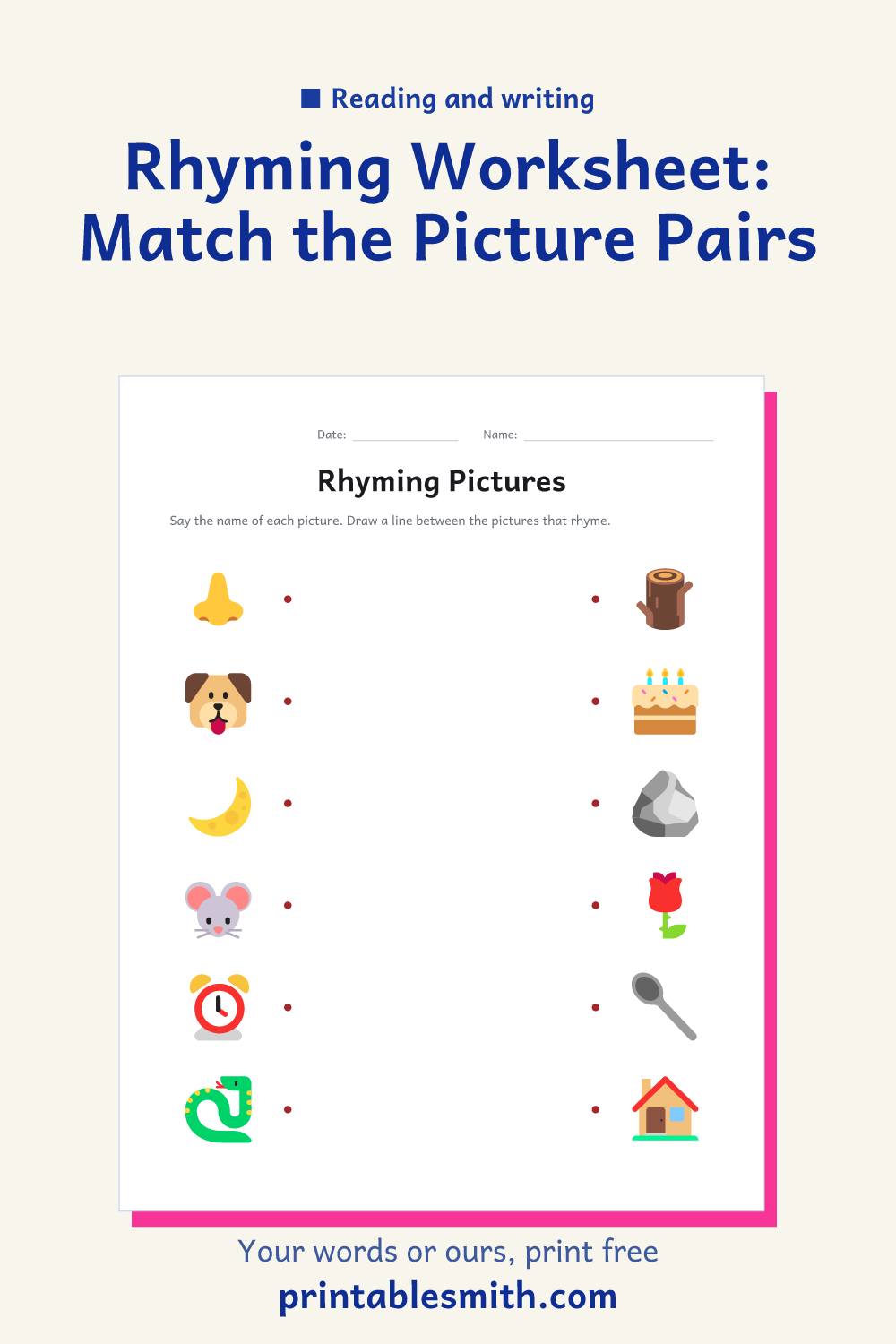
Hearing a rhyme is one of the first steps in learning to read: a child who knows that "moon" and "spoon" end the same way is starting to hear the parts inside words. Each sheet has six pictures on the left and their rhyming partners mixed up on the right, with a dot beside each. The child says the names and draws a line between the pairs.
Some pairs are spelled the same at the end, like cat and hat, and some are not, like bee and key, drum and thumb, or fly and pie. That is on purpose: rhyme is about sound, so the sheet works for children who cannot read yet. Tick "The word under each picture" for a child who is starting to read.
A speech therapist uses the sheet with a four-year-old who says "cat" and "dog" rhyme. They say each pair together, louder on the end, then take turns finding a third word for each: cat, hat, bat.
How to make a rhyming worksheet
- Choose how many pages; each page deals six of the 19 pairs, never two pairs that rhyme with each other.
- Tick the word under each picture if you want it.
- Press New mix for different pairs, and pick a color or black to save ink.
- Download the PDF or print.
Save it for later
Pin this sheet to find it again next time, or to share it with another teacher or parent. The link brings them straight to this page, ready to print.
Save to PinterestTips for teaching rhyme
- Say the names together before drawing lines, so everyone agrees a hat is a hat.
- Stress the ending: "m-OON, sp-OON."
- Ask for a silly third rhyme for each pair; made-up words count.
- Read rhyming picture books and pause before the rhyming word for the child to fill in.
Rhyming questions
What are rhyming words?
Words that sound the same from the last vowel to the end, such as cat and hat, or bee and key.
Do rhyming words have to be spelled the same?
No. Rhyme is about sound, so "bee" and "key" rhyme, and so do "fly" and "pie". Words spelled the same at the end, like cat and hat, are a word family as well.
How do you teach rhyming to preschoolers?
Read rhyming books and songs, stress the ending of each rhyme, then ask "Do these rhyme?" with pairs and non-pairs. Matching pictures comes next, then making up rhymes.
What age do children learn to rhyme?
Many children start hearing rhymes at three or four and can make their own rhymes by about five, though it varies widely.
What if my child cannot hear rhymes yet?
Keep it playful and short. Say two words and ask if they sound the same at the end, giving many pairs that do and some that do not, and come back to the sheet in a few weeks.