How I have, who has works
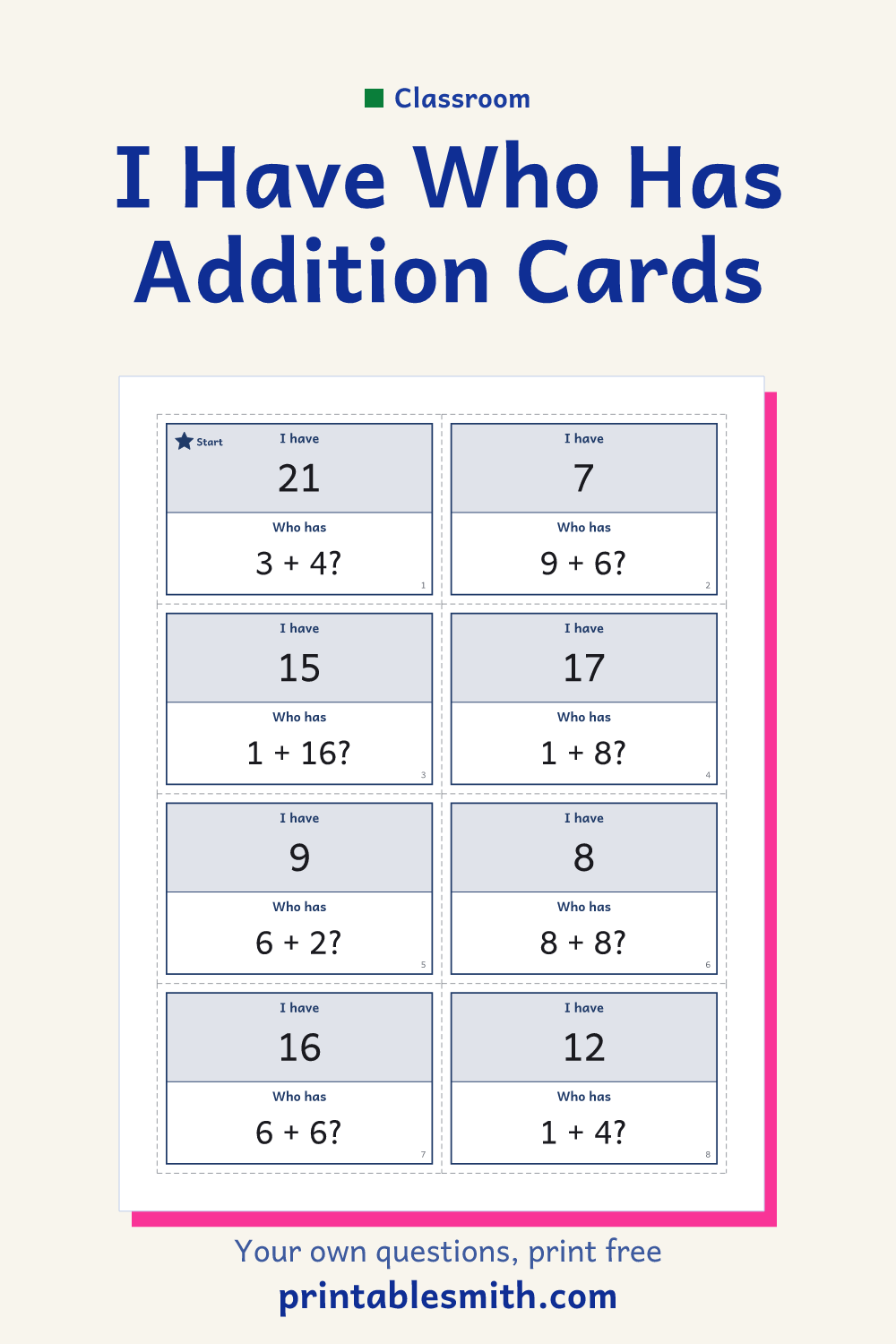
I have, who has is a whole-class game. Every child holds a card. The child with the start card reads the question at the bottom, “Who has 3 + 4?”, and the child whose card says “I have 7” reads their own question next. The cards make one loop, so the game goes around the room and ends when the last question brings it back to the first card.
On this page every answer in a set is different, so only one card ever answers a question. Pick addition, subtraction or multiplication facts, clock faces to the hour, half hour, quarter hour or 5 minutes, or type your own words with their meanings. Choose 12 to 40 cards, in fours, and 4, 8 or 12 a page; the teacher key lists the cards in the order the game goes.
A second grade class of 24 plays the addition set before lunch while the teacher times them. The first round takes four minutes. On Friday they play the same cards, printed again from the Copy link, and beat it by a minute.
How to make I have, who has cards
- Choose where the cards come from: a kind of math fact, telling time, or your own words with meanings after a dash.
- Choose how many cards, in fours from 12 to 40, as close to your class size as you can, and 4, 8 or 12 a page.
- Press “New cards” for a different set and order. Keep the teacher key on to have the order in front of you.
- Download the PDF, cut the cards apart on the gray lines, and hand them out in any order.
Save it for later
Pin this sheet to find it again next time, or to share it with another teacher or parent. The link brings them straight to this page, ready to print.
Save to PinterestMore sheets from this maker to pin:


Tips for the game
- Make one card for each child. With fewer children, give a few of them two cards.
- Hand out the start card, marked with a star, to a confident reader.
- Keep the teacher key on your clipboard: if the game stalls, you can see who has the answer.
- Time each round and write it on the board, so the class plays to beat its own time.
- Collect the cards in the order the game went, and the set is ready for the next round.
I have, who has questions
How do you play I have, who has?
Give every child a card. The child with the start card reads “Who has” and the question. Whoever has that answer says “I have”, reads their answer, then reads their own question. Play goes on until the question on the last card is answered by the first card.
How do I make an I have, who has game?
On this page, choose math facts, telling time or your own words, then the number of cards, and download the PDF. The cards are built as one closed loop with no answer used twice, and the teacher key lists them in order.
Is there an I have, who has game for multiplication?
Yes. Choose multiplication facts: the cards use the times tables from 2 to 12, and every product in a set is different, so no two cards answer the same question.
Can I use my own vocabulary words?
Yes. Choose “My words and meanings” and type one word a line with its meaning after a dash. Each card says “I have” and its word, then asks “Who has the word that means…” with the next card’s meaning. You need at least 6 words.
What if I have fewer students than cards?
Give some children two cards, or make a smaller set. Math and clock sets come in fours, from 12 to 40 cards; a words set takes any number from 6 to 40.
How many cards should a set have?
One card for each child, so everyone plays. A set of 24 suits most classes; 12 suits a small group, and 40 suits two classes playing together.