A record of every night’s reading
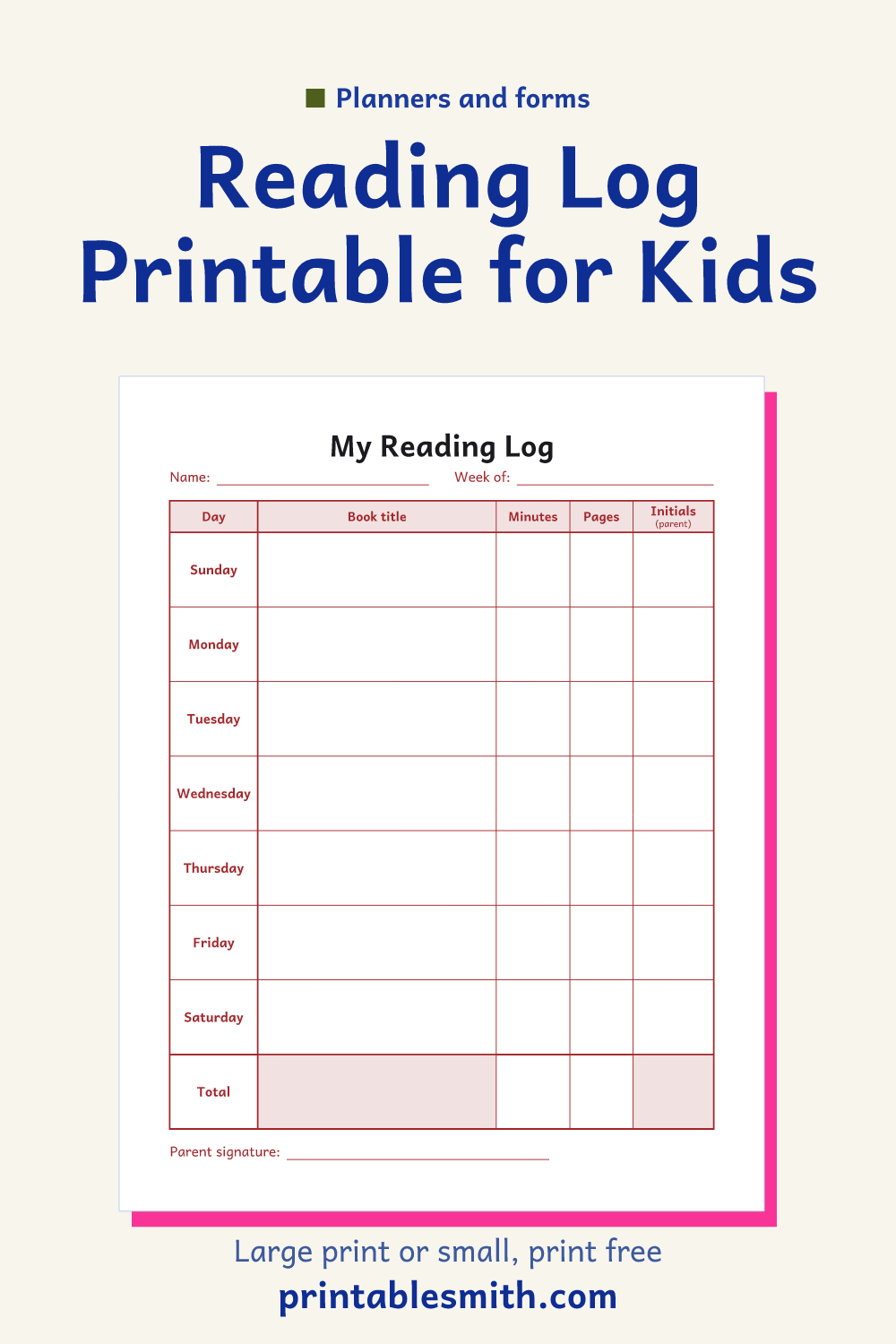
A reading log is a sheet where a reader writes down what they read and for how long, and a grown-up signs to say it happened. Many schools send one home each week, and families use them for summer reading and library challenges. This maker prints five kinds: a week with a row a day and a totals row, a month of 31 numbered days for any month, a list of books read with three faces for how each one was, a log with lines under each book for a summary, and a bookshelf of 25, 50 or 100 books to color in.
A second-grade teacher sends the weekly log home in every Friday folder. On Monday night a child reads a dinosaur book for 20 minutes, writes 20 in the box and 14 pages beside it, and a parent initials the row. On Friday the totals row adds up the week, the parent signs on the line under the table, and the sheet goes back in the folder.
How to make a reading log
- Choose a layout: a week, a month, books read, with a summary, or a bookshelf.
- Keep the Pages column if your class counts pages, and Parent initials if a grown-up signs off each day or each book. The week adds a signature line under the table.
- For a bookshelf, choose 25, 50 or 100 books. Each one has a number, to color when a book is finished.
- Change the title to the reader’s name or the challenge, such as “Summer Reading”.
- Choose a color under Look, or Black for a log a child can color, then download the PDF and print one for each reader.
Save it for later
Pin this sheet to find it again next time, or to share it with another teacher or parent. The link brings them straight to this page, ready to print.
Save to PinterestTips for a reading log that gets filled in
- Keep the log in the book bag or on the fridge, with a pen beside it, so it is there when the reading happens.
- Fill it in right after reading, while the title and the page number are still in front of you.
- Ask your teacher whether reading aloud, audiobooks and reading to a younger sibling count.
- Over a school break, the month layout covers the whole month on one sheet, with no start day to choose.
- Color a book on the shelf for each book finished and pin it up. A full shelf is something to show a grandparent.
Common questions
What is a reading log?
A sheet where a reader writes down each day’s reading: the book, the minutes and often the pages, with a parent’s initials or signature to confirm it. Teachers use them to see how much reading happens at home, and readers use them to count the books they finished.
What should be in a reading log?
The date or day, the book title, the minutes read and a place for a grown-up to initial. Pages read, the author and a totals row help too. Turn the Pages column and the initials on or off here.
How do you fill out a reading log?
After reading, write the title, how many minutes you read and how many pages, then ask a grown-up to initial the row. At the end of the week, add up the minutes in the totals row and ask a grown-up to sign the line under it.
Can I print a reading log with a parent signature?
Yes. Keep Parent initials on. The week has an initials column and a parent signature line under the table; the month has an initials line in each day, and Books read and With a summary have an initials column.
How does the bookshelf reading log work?
It is a picture of a bookshelf with numbered books. Each time a reader finishes a book, they color one in, until the shelf is full. Choose 25, 50 or 100 books.
Can I print a monthly reading log calendar?
Yes. Choose A month. It prints 31 numbered days in rows of seven, with lines for minutes, pages and initials in each, and a box for the month’s minutes and books finished. Write the month at the top, so one print works for any month.
Is there a reading log with a summary?
Yes. Choose With a summary. Each book gets a row for the date, title, author and pages, with three lines under it to write what it was about.
Is there a reading log for adults?
Yes. Books read and With a summary work for any age: change the title, turn off Parent initials, and keep a page in the back of the book you are reading.