What kakuro is
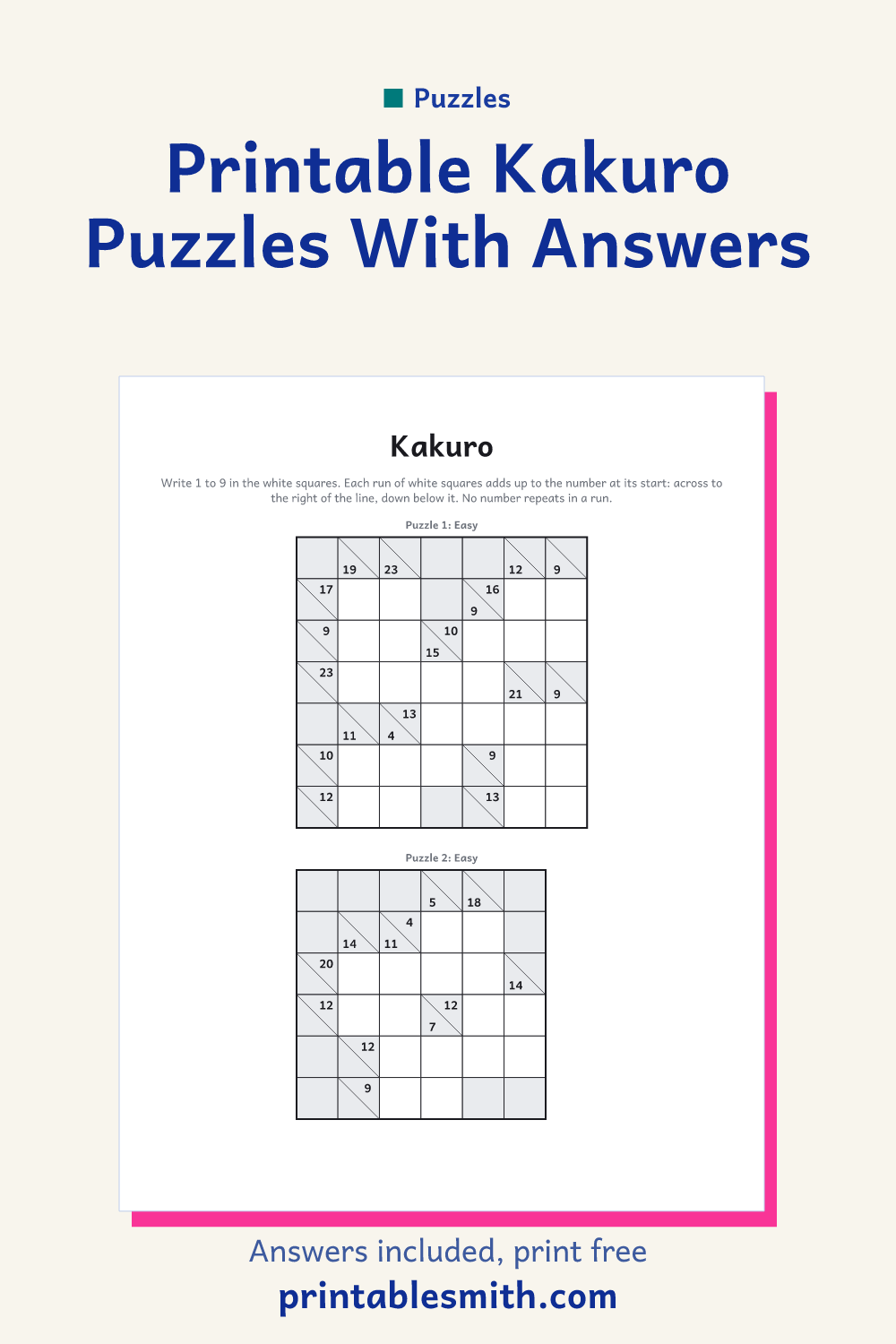
A kakuro grid has white squares to fill and clue squares split by a diagonal line. The number to the right of the line is the sum of the run of white squares going across; the number below the line is the sum of the run going down. Write 1 to 9 so each run adds up to its clue, with no number twice in one run. There are no rows of nine and no 3 × 3 boxes, so the runs do all the work. Some puzzle books call it cross sums.
A volunteer who runs a puzzle club at a public library prints two stacks before each meeting: easy grids printed large, one a page, for newcomers, and hard grids for the regulars. The answer pages stay at the front desk. The cheat sheet goes to anyone who asks how the regulars know at a glance that 16 in two squares must be 7 and 9.
The clue squares print light gray, not solid black, so a stack of kakuro does not empty the printer’s black cartridge. Each level has 60 puzzles, each with exactly one answer, and New puzzles picks others from the same level. Easy grids are 6 × 6 or 7 × 7 with short runs, medium are 8 × 8 or 9 × 9, and hard are 10 × 10 to 12 × 12 with long runs. On the answer pages, the numbers that fill the white squares are printed in red.
How to print kakuro puzzles
- Choose a Level. Easy prints 6 × 6 or 7 × 7 grids, medium 8 × 8 or 9 × 9, and hard 10 × 10 to 12 × 12.
- Choose up to 24 grids in How many puzzles, then 1, 2 or 4 in Puzzles a page (Large print allows 1 or 2).
- Keep Add the answers for the solved grids at the back. The box labeled Add a page of sums prints the combinations page last.
- Pick US Letter or A4, tick Print in OpenDyslexic if you want it, and press Download PDF.
- Copy link to these puzzles gives an address that prints the same grids again, for a club where everyone works the same puzzle.
Save it for later
Pin this sheet to find it again next time, or to share it with another teacher or parent. The link brings them straight to this page, ready to print.
Save to PinterestMore sheets from this maker to pin:


Tips for kakuro
- Look first for runs with one way to make them: 3 in two is 1 + 2, 4 in two is 1 + 3, 16 in two is 7 + 9, and 7 in three is 1 + 2 + 4.
- Where a one-way across run crosses a one-way down run, the shared square often has only one number the two runs agree on.
- Middle sums such as 10 in three can be made four ways, so leave them until their crossing runs have narrowed things down.
- Pencil the candidates small along the top of a square, and rub them out as each run closes.
- Print hard grids one to a page. At 10 × 10 to 12 × 12 the squares get small when more share a sheet.
Kakuro questions
How do you play kakuro?
Write a number from 1 to 9 in each white square so that every run across and down adds up to its clue, with no number used twice in a run.
Is kakuro harder than sudoku?
Not at the easy level. An easy kakuro needs only addition and a few steps of logic, and it can feel gentler than a sudoku. The hard 12 × 12 grids are a long puzzle by any measure.
Is there a kakuro cheat sheet?
Yes. It is the box called Add a page of sums: a final page showing every way to make each run’s sum from 2, 3 or 4 different numbers, one-way sums printed in bold.
Is there only one solution to a kakuro?
Yes, for every puzzle here. A well-made kakuro has exactly one, and each grid in this bank was checked for it.
What are good tricks for kakuro?
Start with the one-way sums, then work where two of them cross. Also check the largest number a run can hold: in a run of two that adds to 4, neither square can be 4 or more.
Can I print kakuro in large print?
Yes. Ticking Large print makes the squares and sums bigger. One a page is the largest it gets, and two a page is next.
Is kakuro good for kids?
Yes, at the easy level, once a child can add three or four numbers up to about 30 in their head.
Why are the clue squares gray?
To save ink. Solid black clue squares use a lot of toner, so these print light gray with dark numbers that stay easy to read.