How a math crossword works
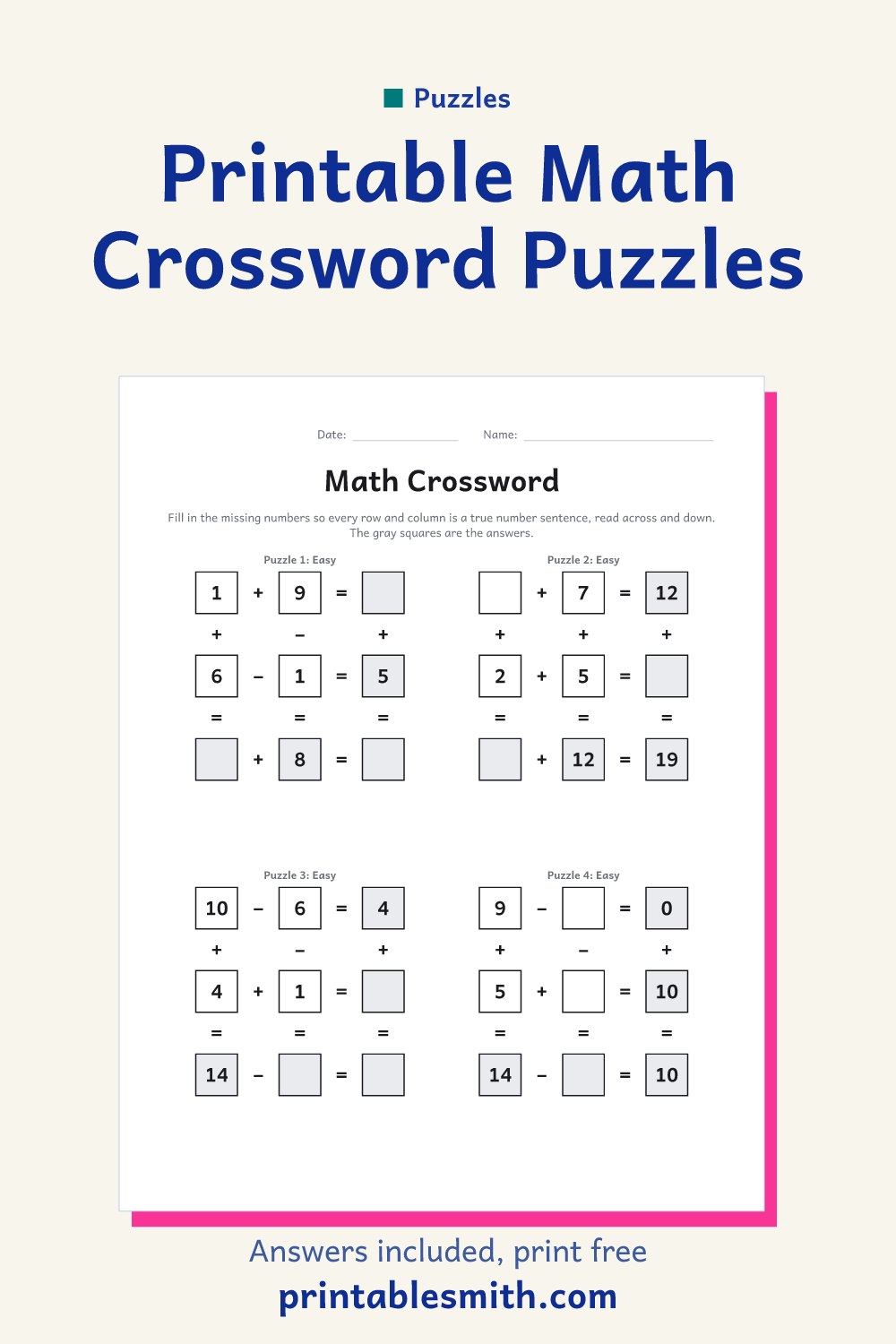
In the small grid, the top two rows each read like 7 + 5 = 12: two numbers and their answer. The columns read the same way, top to bottom. The bottom row and the right column are printed gray because they hold the answers, and the corner square answers both of them. The big grid is 4 × 4, with three numbers and the answer in each sum, and its corner square is left empty. Some squares are blank, and the puzzle is to fill them so every sentence across and down comes out true.
On summer mornings at a kitchen table, a parent prints two sheets from this page: small grids of adding and subtracting at easy for a second grader, and big grids with all four signs at medium for a fifth grader. Both take about fifteen minutes. The answer pages stay on the counter, and whoever finishes first gets to mark the other sheet.
The levels change the size of the numbers. Easy stays within 20, or 50 when times or divide are ticked, with times tables to 5. Medium goes to 50, or 100 with tables to 10, and hard to 100, or 200 with tables to 12. Harder levels also leave more blanks: 3, 4 or 5 in a small grid, and 4, 5 or 6 in a big one. The blanks are placed so you can always find a sentence with just one of them, which gives each puzzle a single answer, and every number is a whole number from 0 up. When a sentence mixes times or divide with plus or minus, the sheet adds “Times and divide come before plus and minus”. The grids print in black ink, and the answer pages mark the filled blanks in red.
How to make math crossword puzzles
- Choose a Grid: Small: 3 × 3, with two numbers in each sum, or Big: 4 × 4, with three.
- Tick the Signs you want, one or more of Add, Subtract, Multiply and Divide. A sum divides at most once.
- Pick a Level. The hint below it gives the number range for each mix of signs.
- Set How many puzzles anywhere up to 36, and choose 1, 2, 4 or 6 for Puzzles a page. Large print keeps it to 1 or 2.
- Leave Add the answers on, choose the paper, and press Download PDF. New puzzles makes another set, and Copy link to these puzzles brings back this one.
Save it for later
Pin this sheet to find it again next time, or to share it with another teacher or parent. The link brings them straight to this page, ready to print.
Save to PinterestMore sheets from this maker to pin:


Tips for math crosswords
- Look for a sentence with only one blank and solve that first. The number you write also sits in a crossing sentence, which now has one blank fewer.
- Use the gray squares as a check: when a row is full, work it again and see that it lands on its gray number.
- Six small grids a page make a warm-up before a lesson; two big grids a page leave room for working in the margins.
- For times tables, tick only Multiply and Divide. A missing factor is a division, so the grid drills each fact both ways.
- Keep a child on one level until a sheet comes back with no mistakes, and move up a level before adding a new sign.
Math crossword questions
How do you solve a math crossword puzzle?
Find a row or column with only one blank, work out the missing number from the others, and write it in. That number also belongs to a sum running the other way, which now has fewer blanks, so keep going until every square is filled.
What are math crossword puzzles also called?
Number crosswords, cross-number puzzles or math cross puzzles. All of them are grids of sums read across and down.
Do the puzzles have answers?
Yes. Every blank is filled in on the answer pages at the end of the PDF.
Which signs can I choose?
Any mix of add, subtract, multiply and divide. A sum divides at most once, and every number in a puzzle is a whole number, so division never leaves a remainder.
What grade are math crosswords for?
First grade and up. Small grids of adding and subtracting at easy suit first and second grade. Big grids with all four signs at medium or hard suit fourth to sixth grade and adults.
Why does the sheet say times and divide come first?
Because sums follow the usual order of operations. In 3 + 4 × 2 you work 4 × 2 first, then add 3, which makes 11. The reminder prints only when a puzzle mixes those signs.