A KWL chart to start and finish a unit
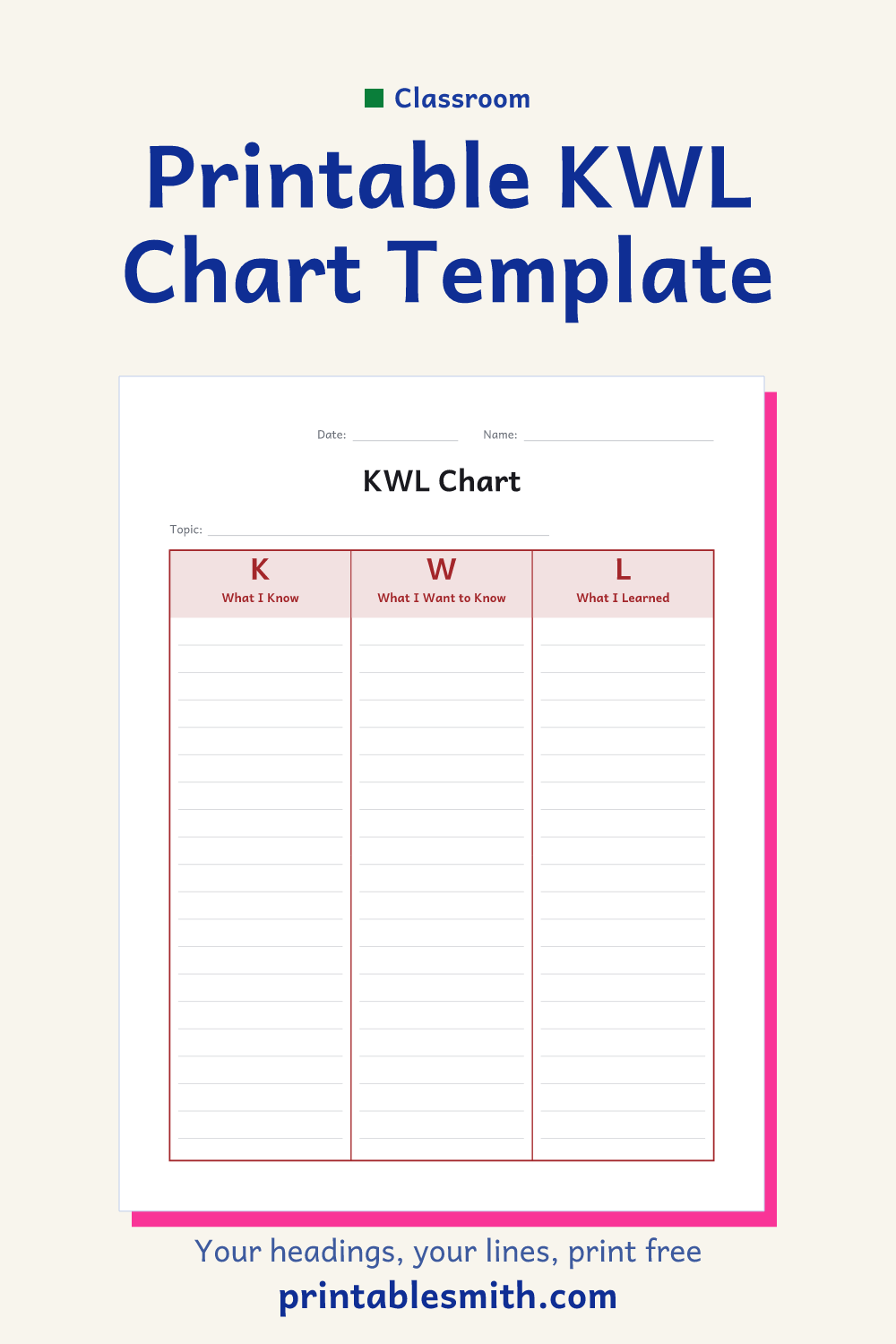
A KWL chart has three columns. Before a lesson, students write what they already Know and what they Want to know. After it, they come back and write what they Learned. The chart shows them, and you, how far they came.
This template also prints the longer versions: KWHL adds How I will learn it, KWLS adds what I Still want to know, and KWLA adds how I feel about it. Each column carries its big letter and a heading you can retype, such as "What I Wonder" in place of "What I Want to Know". A topic line runs across the top.
A third grade class starting a unit on volcanoes fills in K and W on Monday, keeps the charts in their science folders, and writes the L column on Friday after the experiment with baking soda and vinegar.
How to make a KWL chart
- Choose KWL, KWHL, KWLS or KWLA.
- Type over any column heading, or keep the usual ones.
- Pick wide, college or primary lines, or none for a class chart with sticky notes.
- Turn on two to a page for half-page charts, or add a filled example about volcanoes to show how one is used.
- Download the PDF or print it, and write the topic on the line at the top.
Save it for later
Pin this sheet to find it again next time, or to share it with another teacher or parent. The link brings them straight to this page, ready to print.
Save to PinterestTips for KWL charts
- Give students a few minutes alone on the K column before sharing, so the quiet ones get their ideas down too.
- Turn "want to know" into real questions with a question mark. They make the L column easier to fill in.
- Cross out anything in K that turned out to be wrong. It is a good moment to talk about how ideas change.
- For a class chart, print with no lines and blow it up on the copier, or fill the columns with sticky notes.
- KWLS suits research projects: the S column becomes the list of what to look up next.
KWL chart questions
What does KWL stand for?
KWL stands for Know, Want to know and Learned. Students write what they know about a topic, what they want to find out, and later what they learned.
What is a KWL chart used for?
It is used before and after a lesson or unit. It brings out what students already know, gives them questions to look for, and shows what they learned at the end.
Is a KWL chart a graphic organizer?
Yes. It is one of the most used graphic organizers in elementary and middle school, a chart of three columns that organizes thinking before, during and after learning.
What are KWHL, KWLS and KWLA charts?
They add a fourth column. KWHL adds How I will learn it, KWLS adds what I Still want to know, and KWLA adds how I feel about what I learned (the A is often called Affect).
When do you fill in the L column?
At the end of the lesson or unit. Some teachers fill it a little each day as students learn, so the chart grows through the week.
Does a KWL chart work for young children?
Yes. With primary lines and a class chart on the board, kindergarten and first grade students can share what they know aloud while the teacher writes, then draw what they learned.