Every 4th grade list
Each list follows one spelling pattern. Open a list for its worksheet, or make a whole spelling week from it.
Homophones
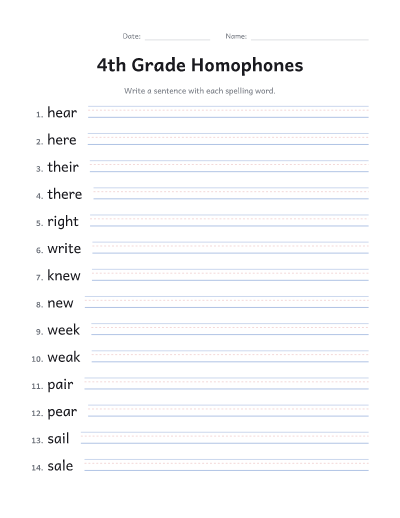
hear and here (14 words)
hear, here, their, there, right, write, knew, new, week, weak, pair, pear, sail, sale
-tion Words
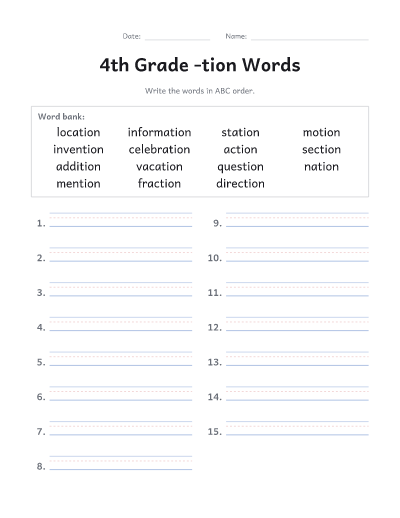
-tion as in station (15 words)
action, nation, motion, station, question, fraction, section, mention, vacation, direction, addition, location, invention, celebration, information
Double Consonant Words
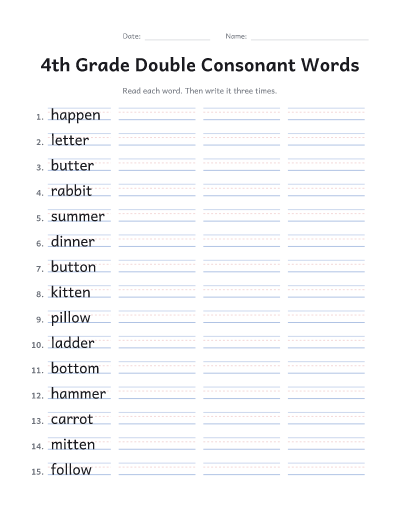
tt, bb, mm, ll and more (15 words)
happen, letter, butter, rabbit, summer, dinner, button, kitten, pillow, ladder, bottom, hammer, carrot, mitten, follow
-le Words
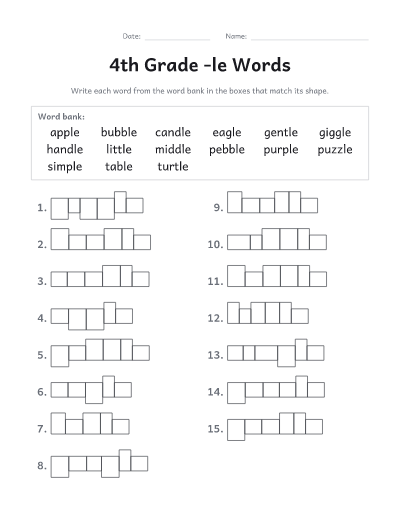
-le as in table (15 words)
table, little, apple, candle, bubble, puzzle, purple, simple, middle, gentle, turtle, giggle, pebble, eagle, handle
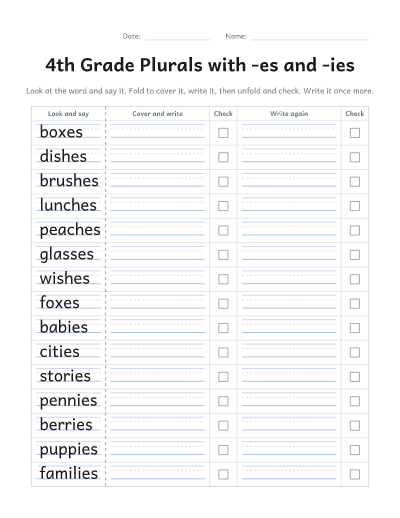
Plurals with -es and -ies
boxes, babies (15 words)
boxes, dishes, brushes, lunches, peaches, glasses, wishes, foxes, babies, cities, stories, pennies, berries, puppies, families
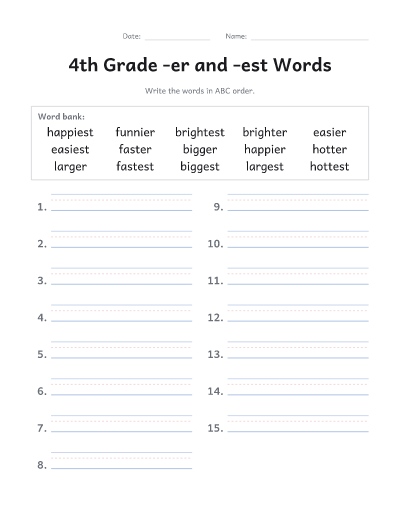
-er and -est Words
big, bigger, biggest (15 words)
faster, fastest, brighter, brightest, larger, largest, bigger, biggest, hotter, hottest, happier, happiest, easier, easiest, funnier
How 4th graders learn to spell
- Teach the rules for joining parts: when to double a letter, drop an e or change y to i.
- Use syllables: split a long word, spell each part, and join them.
- Learn the common endings as wholes, such as -tion and -le.
- Spell homophones by meaning, since sound cannot help.
A spelling week in 4th grade
- Monday: Read the list, name the rule, and ask children to explain it to a partner.
- Tuesday: Print the sheet the list opens with; Sentences and ABC order ask for the most thinking.
- Wednesday: Use the rule on new words from science, math or social studies.
- Thursday: Check the list words in a piece of the children’s own writing.
- Friday: Give the Spelling test, saying every word in a sentence.
Mistakes to watch for
- Forgetting the joining rules. Hopeing, babys, biger. Each one breaks a joining rule. Ask children to name the rule before they fix the word.
- Mixing up homophones in writing. There for their passes a spell check. Read writing aloud and ask what each homophone means.
- Leaving out a syllable. Rember for remember, intresting for interesting. Clapping the syllables before writing catches most of these.
What US standards expect in 4th grade
US state standards ask fourth graders to spell grade-level words correctly and to check spellings in a reference, such as a dictionary, when they are not sure. Most fourth grade programs teach the rules for adding endings and the common endings themselves, which is what these six lists hold.
Ideas for the year
- Work on one rule a week, and come back to it whenever the rule turns up in writing.
- Let children check their own ABC order and word shape sheets with the answer page.
- Pick five words each week for children to use in a piece of their own writing.
Any word can be changed above before you print, and the same list prints as any of the six sheets: a test, ABC order, word shapes and more.