A story map for reading and writing stories
A story map lays out the parts every story has: who is in it, where and when it happens, the problem, the events in order and how the problem is solved. Filling one in after reading checks understanding; filling one in before writing gives a student a plan.
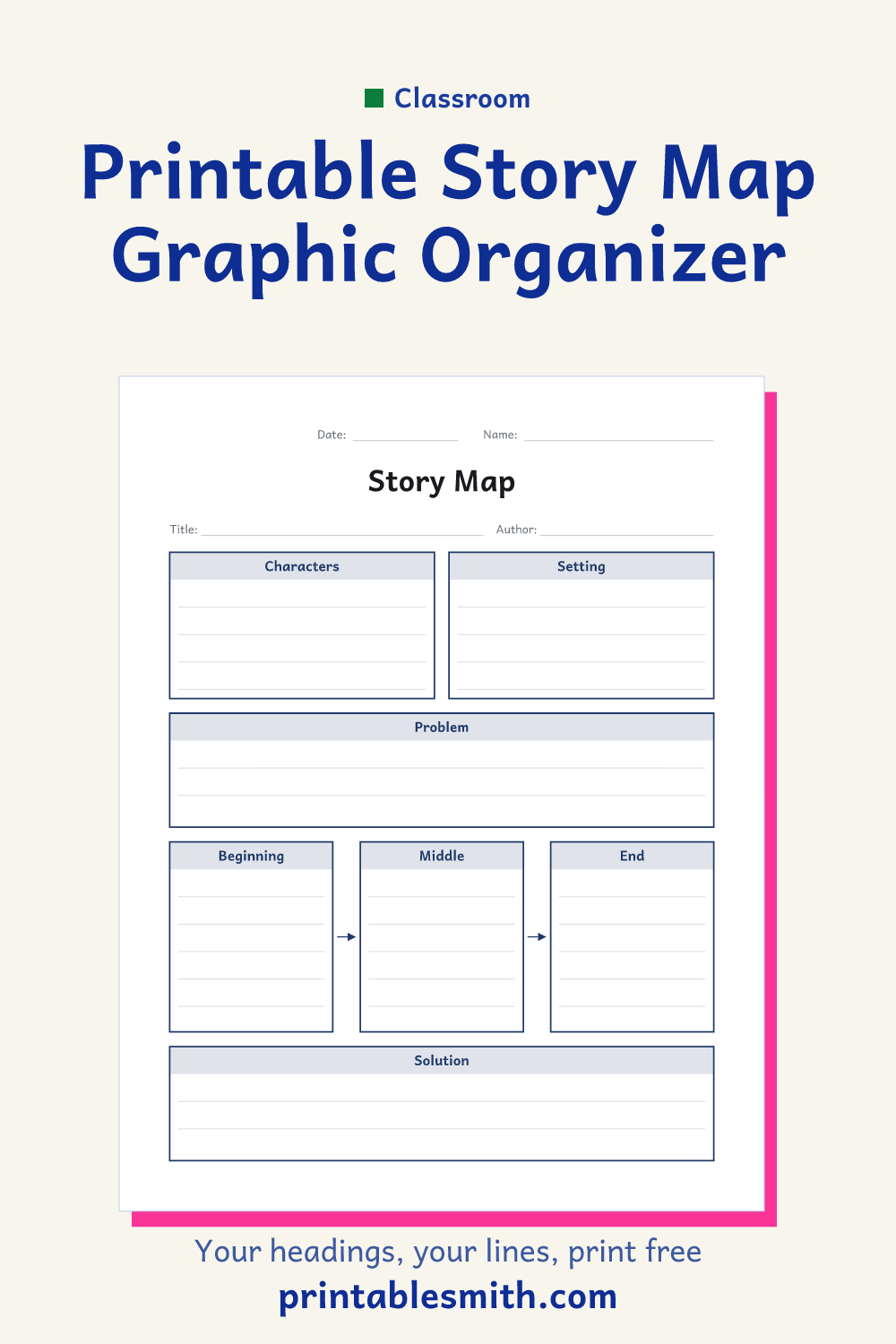
This one has lines for the title and author across the top, then boxes for characters and setting side by side, the problem, three event boxes joined by arrows for the beginning, middle and end, and the solution across the bottom. Every heading can be retyped: First, Then and Finally for the events, or Somebody, Wanted, But, So for the boxes in a summary.
A first grade teacher reads The Tortoise and the Hare aloud, then hands out the story map with primary lines and room to draw in each box, so students can draw the hare asleep under a tree and write one sentence underneath.
How to make a story map
- Type over any heading, or keep characters, setting, problem, beginning, middle, end and solution.
- Pick wide, college or primary lines.
- Turn on room to draw for young students: the top of each box stays blank for a picture.
- Add a filled example of a fable to show the class what goes in each box.
- Download the PDF, or print a copy for each reading group to fill in after the story.
Save it for later
Pin this sheet to find it again next time, or to share it with another teacher or parent. The link brings them straight to this page, ready to print.
Save to PinterestTips for story maps
- Fill in the problem first. Once students know it, the events and the solution are easier to find.
- Ask for one sentence per event box, in order, using the words first, next and last.
- Use the same map to plan a story of their own: a character, a place, a problem, and three things that happen.
- For a book with many events, use the sequence chart in the graphic organizer maker for the middle, with up to eight boxes.
- Retype the boxes for a retelling of a nonfiction text: Who, What, Where, When, Why.
Story map questions
What is a story map graphic organizer?
A story map is a graphic organizer for the elements of a story: characters, setting, problem, events and solution, in boxes on one page.
What are the elements of a story map?
The usual elements are the title and author, characters, setting, problem, the events at the beginning, middle and end, and the solution.
How do you make a story map?
Read or plan the story, then fill each box: who the characters are, where and when it happens, the problem, what happens first, next and last, and how it ends.
Which graphic organizer is used for stories?
A story map is the main one. A sequence chart works for the order of events, a storyboard for planning a story in pictures, and a Venn diagram for comparing two stories.
How is a story map different from a plot diagram?
A story map lists the parts of a story in boxes. A plot diagram draws the rise and fall of the action as a line, from exposition to climax to resolution, and suits older students.
How do you teach a story map in kindergarten?
Read a short story aloud, fill a story map together on the board, then let children draw each part with room to draw and primary lines for a word or two.
What is somebody wanted but so then?
It is a way to summarize a story in one sentence: Somebody (a character) Wanted something, But a problem got in the way, So they did something, Then it ended. Retype the story map’s boxes to use it.