How to compare numbers with greater than and less than
- Compare the digits in the largest place first: hundreds, then tens, then ones.
- If those digits are the same, move one place to the right and compare again.
- Write > when the first number is greater, < when it is less, and = when the two are the same.
- The open side of the sign always faces the greater number.
Write both numbers on a place value chart, one under the other, and compare them place by place from the left.
A worked example
Compare 347 and 374
- Both numbers have 3 hundreds.
- Look at the tens: 4 tens is less than 7 tens.
- So 347 is less than 374: 347 < 374.
Common mistakes
- Looking only at the last digit. In 29 and 31, the 9 is bigger than the 1, but 3 tens beat 2 tens, so 29 < 31.
- Writing the sign backward. Point the small, closed end at the smaller number. Some children put two dots beside the greater number and one beside the smaller, then join them.
- Thinking 9 is greater than 10 because 9 is the bigger digit. Count the digits first: a 2-digit number is always greater than a 1-digit number.
Which grade it suits
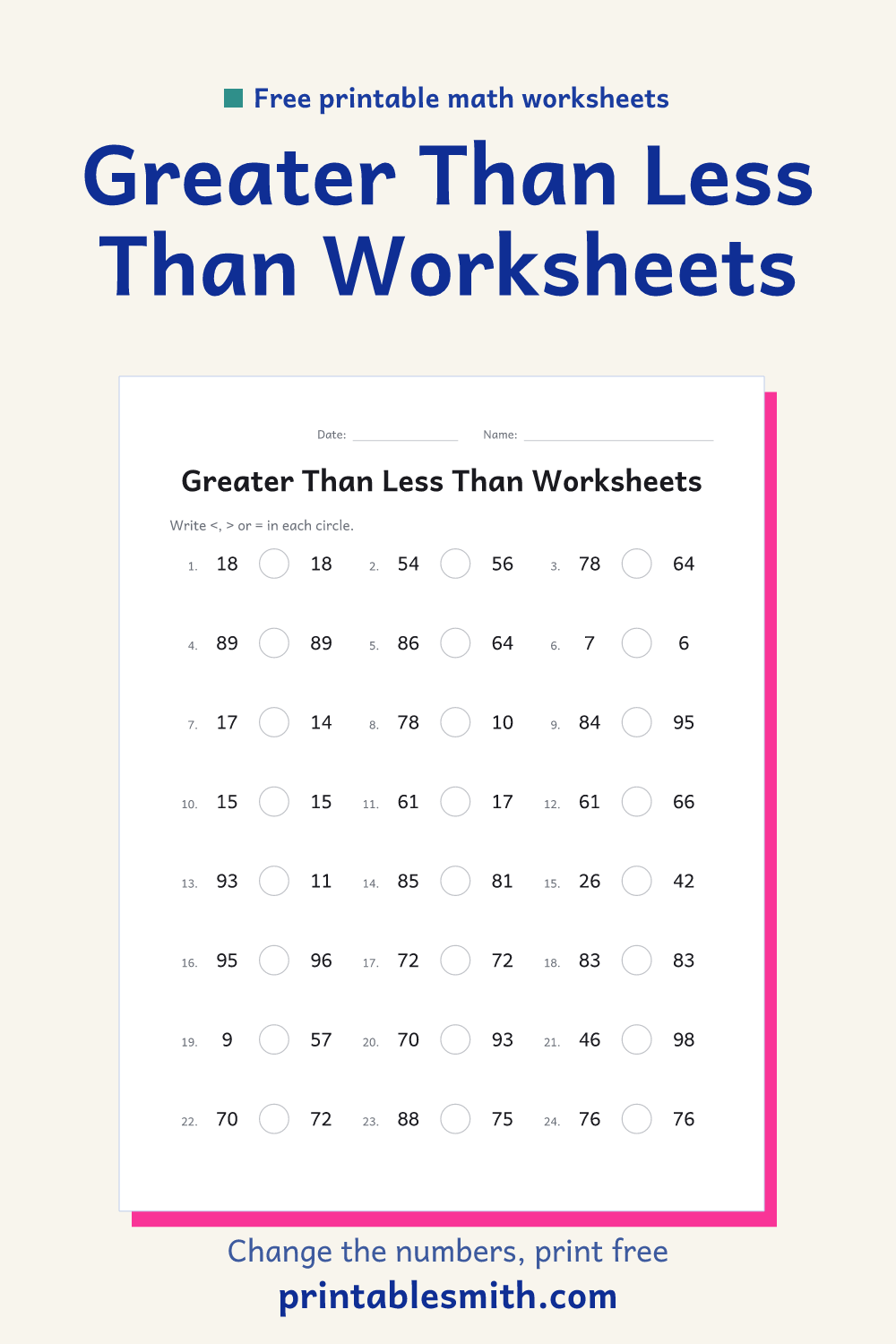
First grade, where US standards ask children to compare two 2-digit numbers with >, = and <. Second grade does the same with 3-digit numbers, and kindergarten compares groups of objects by counting them.
Ideas for using these sheets
- Before the sheet, build two towers of cubes for 7 and 4 and ask which is taller, then write 7 > 4 under them.
- Read each finished problem aloud as a sentence: “53 is greater than 35.”
- For kindergarten, switch “Compare” to groups of pictures; for second grade, to numbers to 1,000.
Every setting can be changed above before you print, and “New problems” makes a fresh sheet as often as you like.
Save it for later
Pin this sheet to find it again next time, or to share it with another teacher or parent. The link brings them straight to this page, ready to print.
Save to Pinterest