How to find a missing part in a number bond
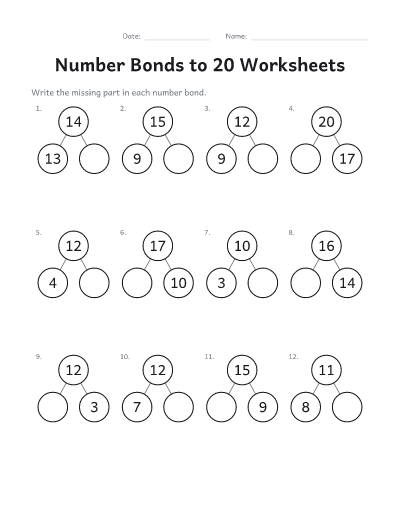
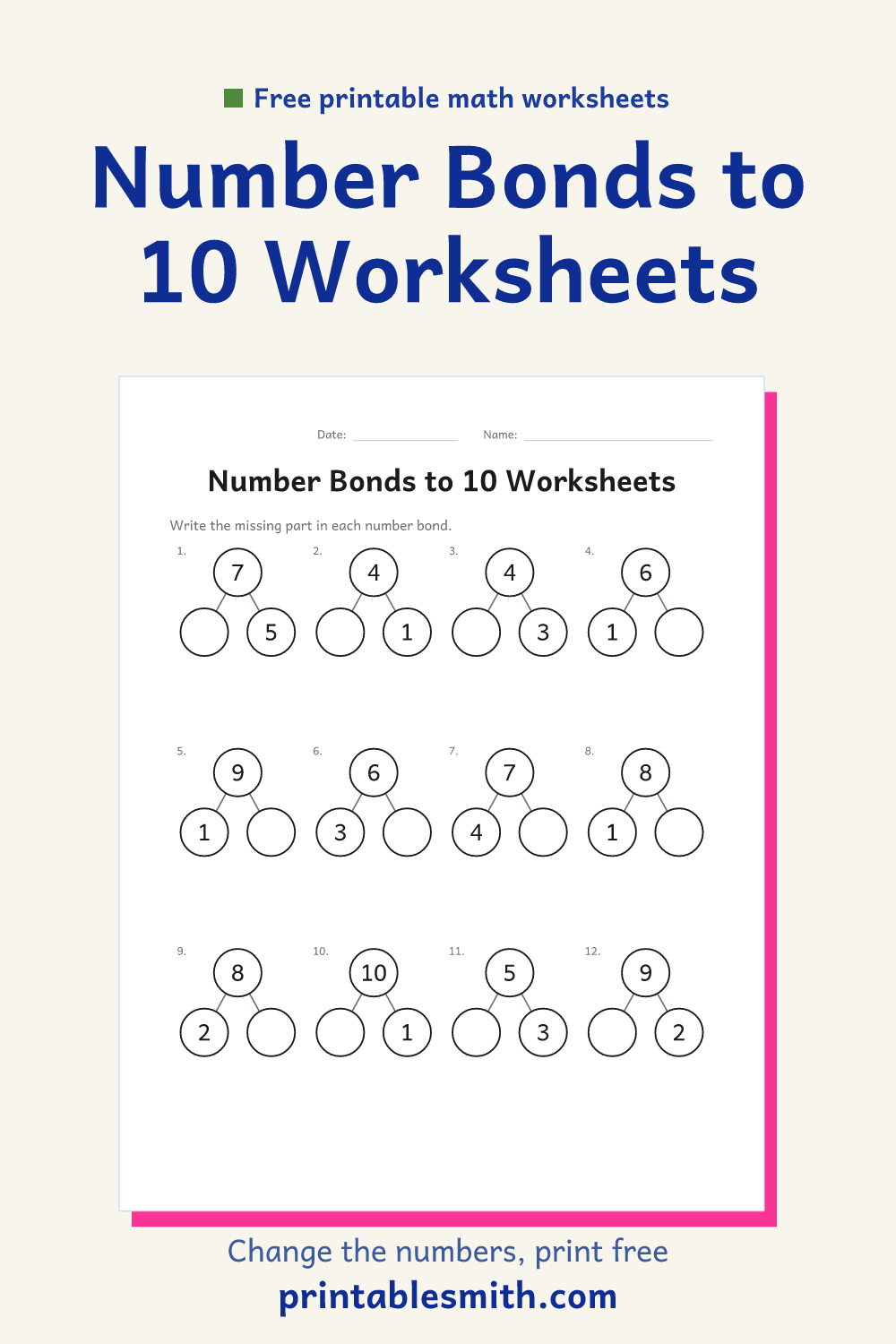
- Read the top circle: it is the whole, the number both parts make together.
- Read the part you are given in one of the bottom circles.
- Count up from that part to the whole, keeping track on your fingers.
- Write how many you counted in the empty circle.
A worked example
Whole 9, one part 6
- The whole is 9 and one part is 6.
- Count up from 6 to 9: 7, 8, 9. That is 3 counts.
- The missing part is 3, because 6 and 3 make 9.
Common mistakes
- Adding the two numbers shown. A child sees 9 and 6 and writes 15. Ask: can a part be bigger than the whole?
- Counting the starting number. Counting “6, 7, 8, 9” gives 4. Start the count on the next number, 7.
- Treating the top circle as a part. Point to the top circle and say “whole” every time, until children say it with you.
Which grade it suits
Kindergarten and first grade. US standards ask kindergartners to split numbers up to 10 into two parts in more than one way, and first graders to add and subtract within 20 using facts like these. Bonds to 20 come next.
Ideas for using these sheets
- Hand out ten counters and let children split them into two piles to check a bond.
- Switch to “Pairs that make 10” for a sheet where every whole is 10, the pairs worth knowing by heart.
- Use counters in two colors, one color for each part, so the split is easy to see.
Every setting can be changed above before you print, and “New problems” makes a fresh sheet as often as you like.
Save it for later
Pin this sheet to find it again next time, or to share it with another teacher or parent. The link brings them straight to this page, ready to print.
Save to Pinterest