How to teach number bonds, step by step
- Split real things: five blocks into two piles, in every way you can.
- Draw the splits as bonds, the whole on top and the parts below.
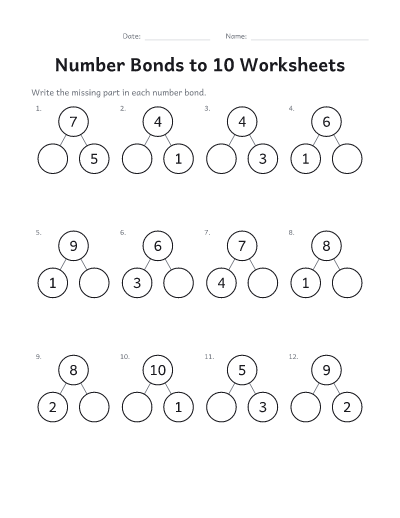
- Hide one part and ask what is missing, first to 5, then to 10.
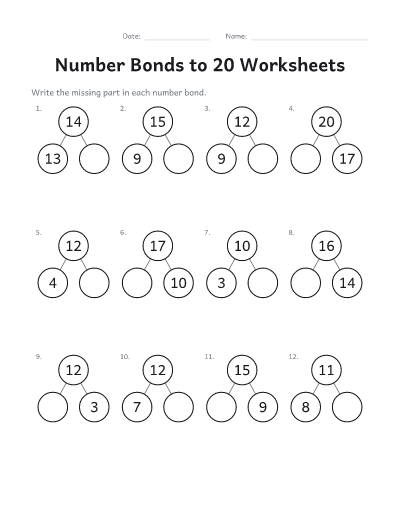
- Learn the pairs that make 10 by heart, then use them for bonds to 20.
Common mistakes
- Learning bonds as a picture only. Say each one as a sentence too: 7 is 4 and 3.
- Moving to 20 before 10 is solid. Bonds to 20 lean on the pairs that make 10. Check those first.
- Never showing a missing whole. Mix in some sheets where the top circle is blank, so the bond is seen as adding too.
Grade by grade
- Kindergarten: splitting numbers up to 10 in more than one way.
- First grade: pairs that make 10 and bonds within 20 for adding and subtracting.
- Second grade: bonds to 100 in tens and fives, for mental math.
Ideas for using these sheets
- Teach bonds before the plus sign: a whole that splits into two parts is easier to picture than a sum.
- Keep one bond on the board all week and ask for a new way to split it each morning.
- Ask for every bond of one number, such as all the ways to split 8, and list them in order.
Every setting can be changed above before you print, and “New problems” makes a fresh sheet as often as you like.