How to teach rounding, step by step
- Place numbers on a number line between two tens and ask which is closer.
- Bring in the rule for the halfway point: 5 rounds up.
- Round to the nearest 100 by looking at the tens digit.
- Round larger numbers to any place, and use rounding to estimate.
A hundreds chart works as a number line in rows: a number in the 5 column or right of it rounds up to the ten at the end of its row.
Common mistakes
- Learning the rule without the number line. Children who know the rule but not why round 45 down to 40, or 350 down to 300. Go back to the line.
- Looking at the wrong digit. Underline the place being rounded to, then circle the digit just to its right.
- Changing digits to the left. Only the rounded place can change, and only by one, unless it carries into the next place.
Grade by grade
- Second grade: placing numbers on a number line.
- Third grade: rounding to the nearest 10 or 100.
- Fourth grade: rounding multi-digit numbers to any place.
- Fifth grade: rounding decimals.
Ideas for using these sheets
- Show rounding on a number line before the rule, so “nearest” means something.
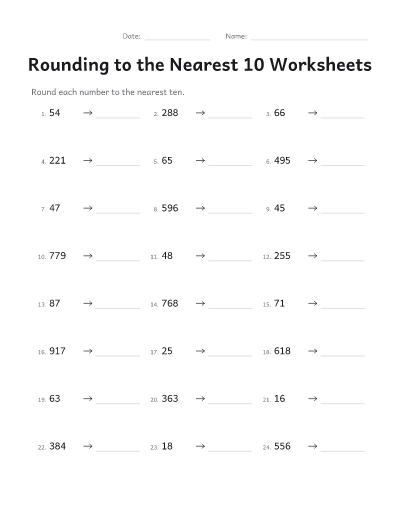
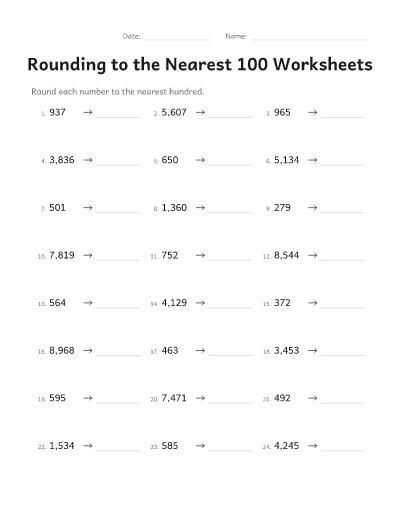
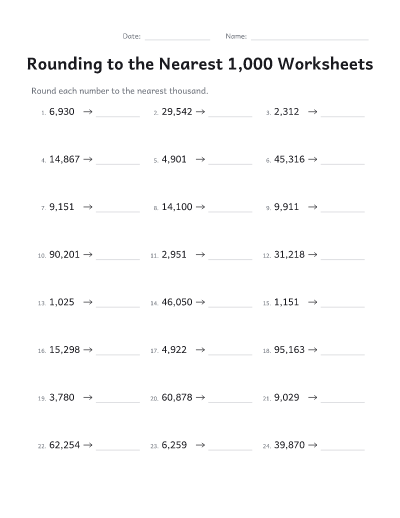
- Practice tens until it is quick, then hundreds, then thousands.
- Use rounded numbers to check sums: 398 + 207 should be close to 400 + 200.
Every setting can be changed above before you print, and “New problems” makes a fresh sheet as often as you like.