How to teach money, step by step
- Learn each coin’s name and value with real coins.
- Count one kind of coin at a time: all dimes, all nickels.
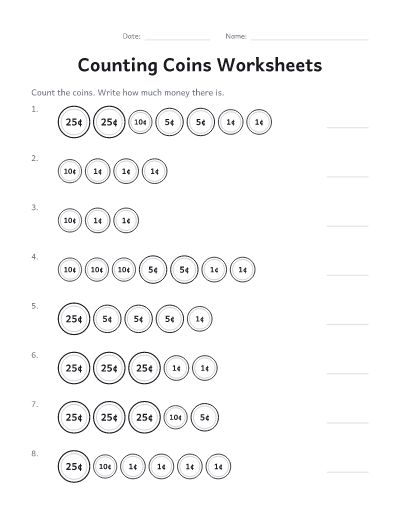
- Count mixed coins, largest value first.
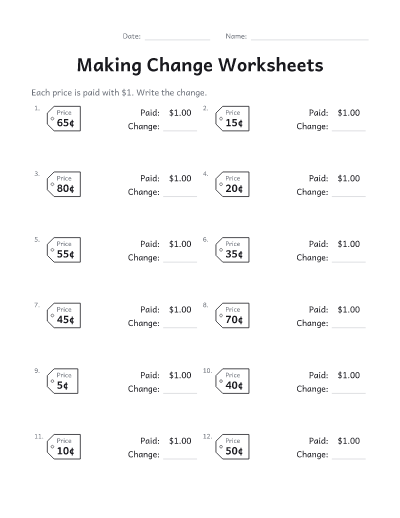
- Add bills, then make change by counting up.
Common mistakes
- Judging coins by size. The dime is the smallest coin but is worth more than the penny and the nickel.
- Mixing cents and dollars. Write 75¢ and $0.75 side by side and show they are the same amount.
- Counting in the order the coins happen to fall. Sort first, largest value first, then count.
Grade by grade
- Kindergarten and first grade: naming coins and their values.
- Second grade: counting coins and bills, with $ and ¢.
- Third and fourth grade: making change and money in decimals.
Ideas for using these sheets
- Sort a handful of mixed coins into piles before counting them.
- Ask for the same amount two ways, such as 25¢ as a quarter or as two dimes and a nickel.
- Set up a class store with price tags from the making change sheet.
Every setting can be changed above before you print, and “New problems” makes a fresh sheet as often as you like.