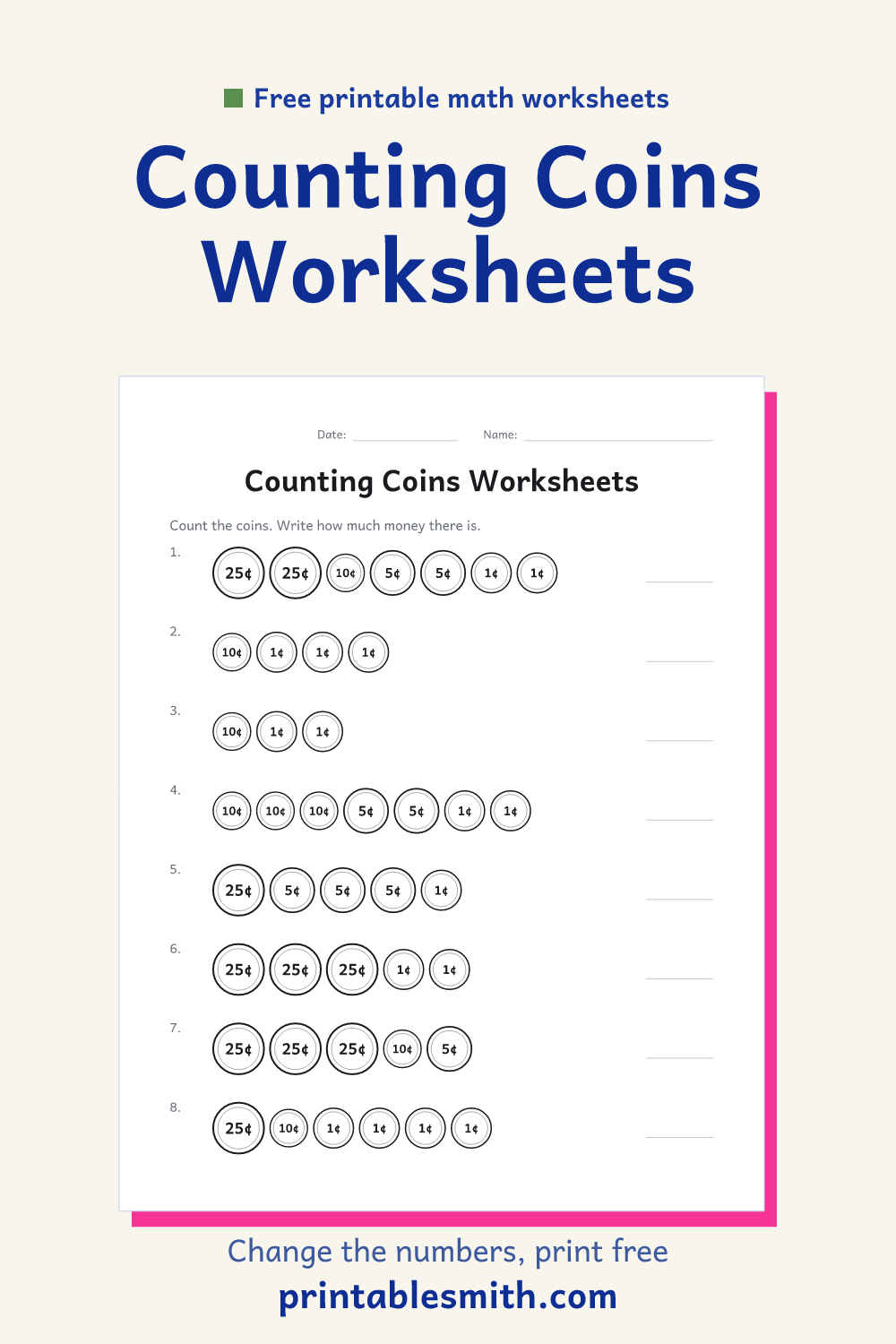
How to count coins
- Name each coin and its value: quarter 25¢, dime 10¢, nickel 5¢, penny 1¢.
- Start with the coin worth the most.
- Count on from it: by 25s for quarters, then 10s for dimes, 5s for nickels and 1s for pennies.
- Write the total with the cent sign.
A worked example
2 quarters, 1 dime, 1 nickel and 2 pennies
- Two quarters: 25, 50.
- Count on the dime and the nickel: 60, 65.
- Count on the pennies: 66, 67. The total is 67¢.
Common mistakes
- Thinking a bigger coin is worth more. The nickel is bigger than the dime but worth half as much. Learn values, not sizes.
- Counting every coin as one. Say the value while touching each coin: “twenty-five, fifty”.
- Switching from 10s to 5s too early. Count all the dimes before any nickel. The sheets already put them in that order.
Which grade it suits
First and second grade. Many states bring in coins in first grade, and US standards ask second graders to solve problems with dollar bills, quarters, dimes, nickels and pennies, using the $ and ¢ signs.
Ideas for using these sheets
- Put real coins on the table and match each drawn coin to one.
- Name a price under a dollar and have children choose coins to pay it exactly.
- Trade five pennies for a nickel and two nickels for a dime, so the values make sense.
Every setting can be changed above before you print, and “New problems” makes a fresh sheet as often as you like.
Save it for later
Pin this sheet to find it again next time, or to share it with another teacher or parent. The link brings them straight to this page, ready to print.
Save to Pinterest