How to make change
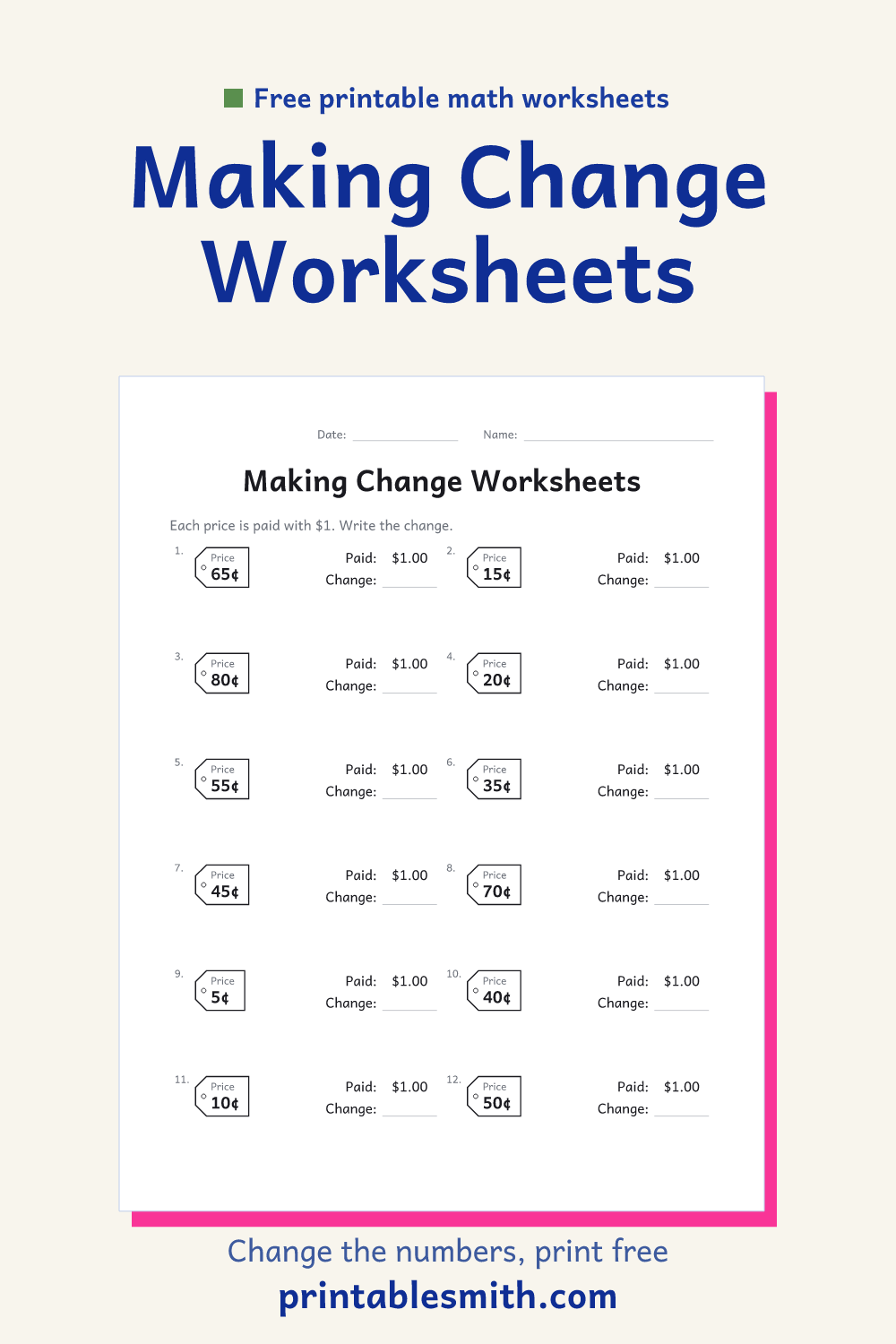
- Read the price on the tag and what was paid.
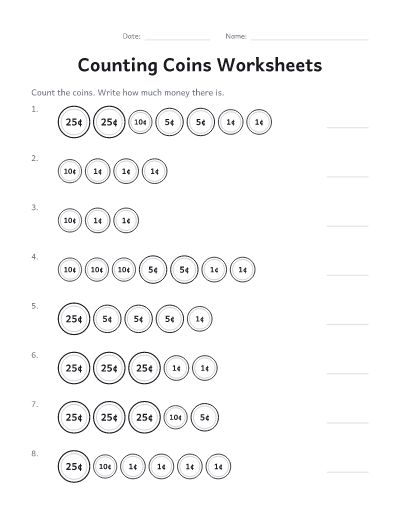
- Count up from the price to the amount paid, using the fewest coins: first pennies or nickels to a round number, then dimes and quarters.
- Add up what you counted. That is the change.
- Check by adding the change to the price: it should equal what was paid.
A worked example
Price 35¢, paid $1.00
- From 35¢, a nickel makes 40¢ and a dime makes 50¢.
- From 50¢, two quarters make $1.00.
- 5¢ + 10¢ + 50¢ is 65¢ of change.
Common mistakes
- Subtracting in columns and slipping on the zeros. $1.00 – 35¢ written as 75¢: the child borrowed but left the tens at 10 instead of 9. Count up instead, the way a cashier does.
- Writing the change in the wrong unit. 65 is 65¢, not $65. Write the sign every time.
- Stopping at the next round number. Counting up from 35¢ to 50¢ is only part of the way. Keep going to $1.00.
Which grade it suits
Second to fourth grade. Second graders solve money word problems, and fourth graders work with money in decimals, which is when change from $5 and $20 fits.
Ideas for using these sheets
- Play store with real coins: one child pays a dollar and the other counts up the change.
- Ask for the change with the fewest coins possible, then check it with real coins.
- Look at a real receipt together and find the line that shows the change.
Every setting can be changed above before you print, and “New problems” makes a fresh sheet as often as you like.
Save it for later
Pin this sheet to find it again next time, or to share it with another teacher or parent. The link brings them straight to this page, ready to print.
Save to Pinterest