How to teach fact families, step by step
- Start with three small numbers, such as 2, 3 and 5, and act out all four facts with counters.
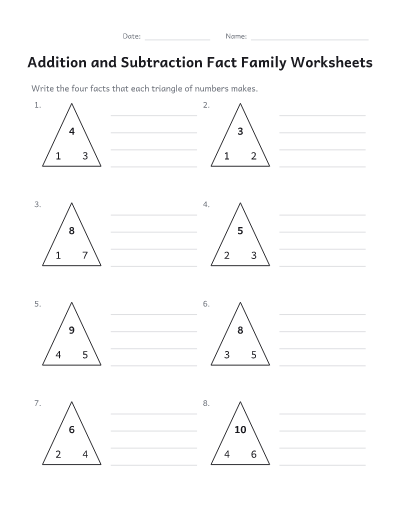
- Show the triangle and write the facts beside it.
- Practice addition and subtraction families to 10, then to 20.
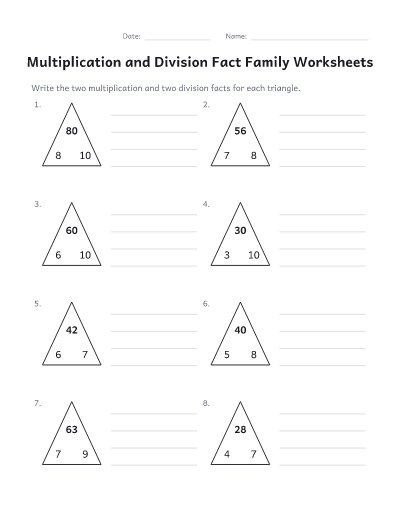
- Use the same triangle for multiplication and division once the times tables begin.
Common mistakes
- Treating subtraction as a separate set of facts to learn. Each subtraction fact is an addition fact turned around. Fact families show that.
- Using doubles first. 4, 4 and 8 make only two facts. Start with two different parts.
- Reading a triangle in any order. Agree that the top number is always the whole or product.
Grade by grade
- First grade: addition and subtraction families within 10, then 20.
- Second grade: families for fluency within 20.
- Third grade: multiplication and division families up to 10 × 10.
- Fourth grade: larger products and the link to factors.
Ideas for using these sheets
- Call the three numbers a family that always travels together: no other number can join a fact.
- Fold a finished sheet so only the triangles show, and ask for the facts out loud.
- Use the addition families before subtraction gets hard, and the multiplication families before division starts.
Every setting can be changed above before you print, and “New problems” makes a fresh sheet as often as you like.