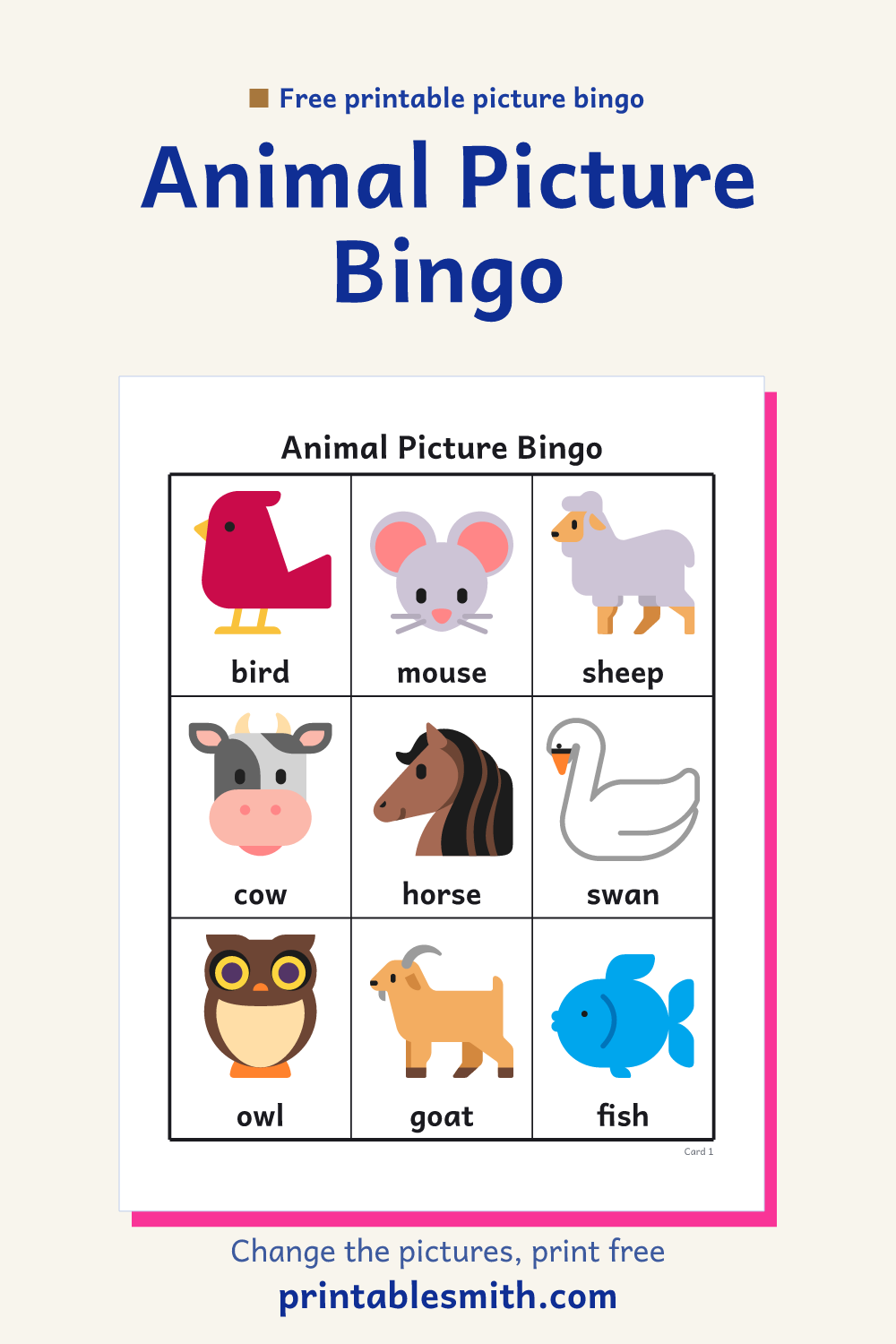
Pictures on the cards
 dog
 cat
 horse
 cow
 pig
 sheep
 goat
 hen
 duck
 bunny
 bird
 mouse
 fish
 turtle
 owl
 squirrel
 swan
 frog
Swap any picture, change the grid or the number of cards, and print as many as you need.
Who this game suits
Eighteen animals most people grew up around, nine to a card. It is the easiest of the five games to follow, and a good choice for a mixed group, for an afternoon when grandchildren visit, or for a player who is new to bingo. A round takes about fifteen minutes.
Running the game with a group
- Start with a practice round of five calls, helping each player find the animals, so everyone knows how the game goes.
- Pair a quicker player with someone who needs more time, and let them share one card between them.
- When grandchildren visit, ask each player to show a child their favorite animal on the card and say why, before the first call.
Calling these pictures
- Say where each animal lives: the cow in the barn, the duck on the pond, the owl up in the old oak.
- The swan and the duck, and the mouse and the rabbit, sit close in shape. Name a feature as you call: the swan’s long neck, the rabbit’s long ears.
- Leave a pause after the dog and the cat. These two bring the most stories, and the game can wait for them.
Ideas for this game
- Make each animal’s sound as you call it, or ask the group to make it with you.
- Ask about the pets and farm animals players grew up with, and their names.
- For a longer game, switch to a 4 × 4 grid; the pictures stay big.
How these cards are made
- Big pictures is already on: one card to a page, with the pictures as large as the page allows and each name printed in bold of 18 points or more beneath it.
- There is no free space, so every square is a real picture to find. Turn it back on under “More” if your group likes a head start on a 3 × 3 card.
- The calling cards come last, three across, big enough to hold up to the room. Cut them out and draw them from a basket, or keep the page whole as a checklist.
- Choose black and white to save ink: the pictures print as bold outlines that stay clear on any printer, and players can color them in another day.
Tips for activity directors and families
- Call slowly, say each name twice and hold up the calling card, so players can follow by sight as well as by ear.
- Use large markers that are easy to pick up and too big to swallow, such as squares of colored cardboard, or let players cross squares out with a thick felt-tip pen.
- Play for a full card rather than a line when the group likes a longer, gentler game.
- Let a player draw the calling cards and show them around; many enjoy being the caller.
- Keep a few spare cards printed, so anyone who joins late can still play.
Save it for later
Pin this sheet to find it again next time, or to share it with another teacher or parent. The link brings them straight to this page, ready to print.
Save to Pinterest