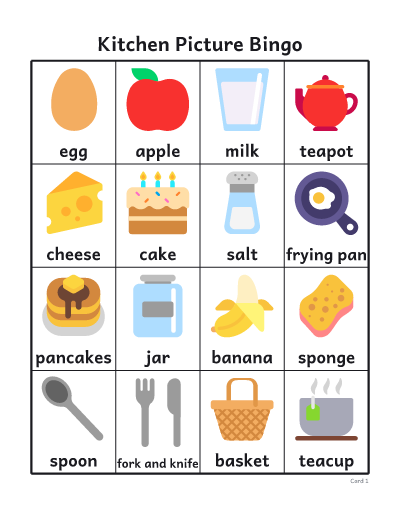
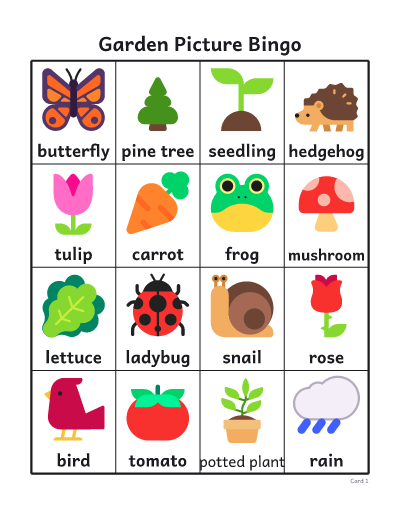
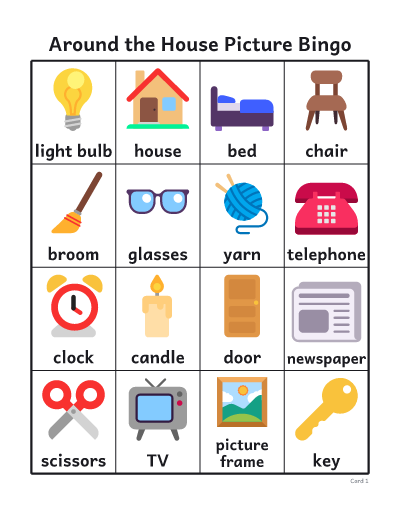
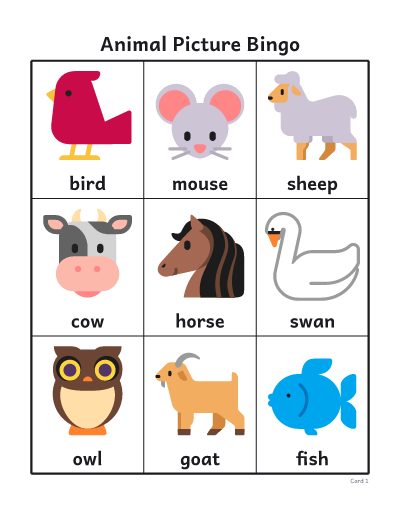
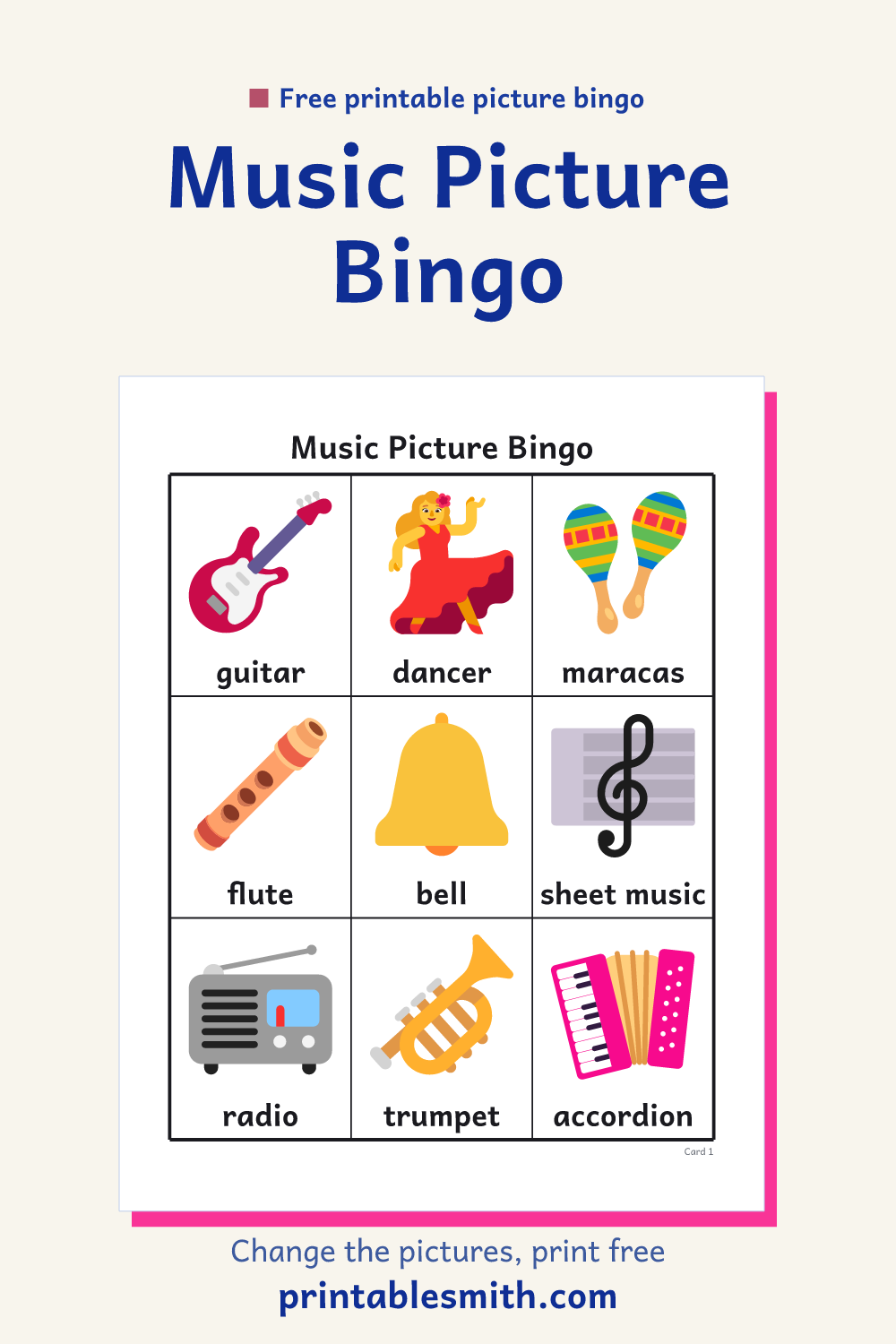
Pictures on the cards
 piano
 guitar
 drum
 trumpet
 saxophone
 flute
 maracas
 accordion
 banjo
 horn
 bell
 radio
 microphone
 music note
 sheet music
 singer
 dancer
Swap any picture, change the grid or the number of cards, and print as many as you need.
Who this game suits
The shortest game of the five: nine pictures to a card from a set of seventeen, so a round takes ten to fifteen minutes and two or three rounds fit one session. It pairs naturally with a music hour or a sing-along, and suits groups that tire quickly, since a line comes up within a few calls.
Running the game with a group
- Play a round, then play one song while players clear their cards, and start the next round when it ends.
- Ask a volunteer to hold up each calling card while you say the name, so the room both sees and hears every call.
- Keep prizes small and plentiful, so most players win at least once in an afternoon.
Calling these pictures
- Describe the sound with the name: the deep beat of the drum, the ring of the bell, the soft, high note of the flute.
- The horn, the trumpet and the saxophone look alike from across a room. Carry those three calling cards close to each table.
- Sheet music and the music note are easy to confuse. Call one as “a page of music” and the other as “a single note”.
Ideas for this game
- Play a few bars of music that features each instrument as you call it, and let players guess before you show the card.
- When the singer or the dancer is called, invite the room to sing a chorus or sway along.
- Ask who played an instrument at school or in church, and which one.
How these cards are made
- Big pictures is already on: one card to a page, with the pictures as large as the page allows and each name printed in bold of 18 points or more beneath it.
- There is no free space, so every square is a real picture to find. Turn it back on under “More” if your group likes a head start on a 3 × 3 card.
- The calling cards come last, three across, big enough to hold up to the room. Cut them out and draw them from a basket, or keep the page whole as a checklist.
- Choose black and white to save ink: the pictures print as bold outlines that stay clear on any printer, and players can color them in another day.
Tips for activity directors and families
- Call slowly, say each name twice and hold up the calling card, so players can follow by sight as well as by ear.
- Use large markers that are easy to pick up and too big to swallow, such as squares of colored cardboard, or let players cross squares out with a thick felt-tip pen.
- Play for a full card rather than a line when the group likes a longer, gentler game.
- Let a player draw the calling cards and show them around; many enjoy being the caller.
- Keep a few spare cards printed, so anyone who joins late can still play.
Save it for later
Pin this sheet to find it again next time, or to share it with another teacher or parent. The link brings them straight to this page, ready to print.
Save to Pinterest